
PUMP IMPELLER ENGINEERING
Open vs Closed Bronze Pump Impellers: What Changes in Service?
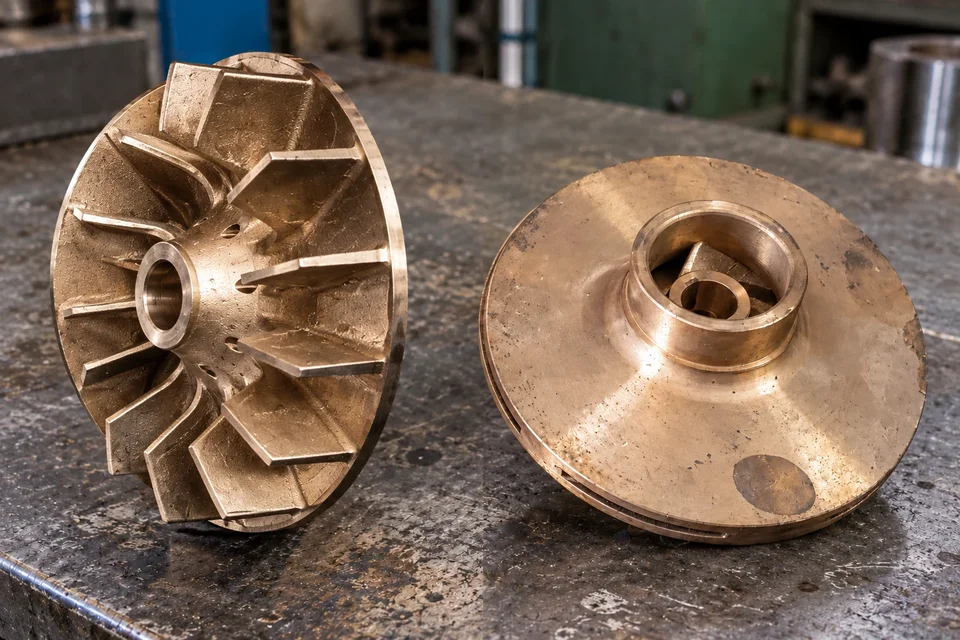
The visible difference between an open and a closed bronze pump impeller is the front shroud. In service, the questions are more specific: where is the working clearance, what happens as it wears, and which surfaces can the maintenance team reach?
For a replacement order, start with the construction already used in the pump. Changing impeller type is a pump-design decision, not a like-for-like substitution based on diameter and shaft bore.
Look at the shrouds before the product name
A closed impeller has vanes between front and rear shrouds. Liquid enters through the suction eye and leaves through passages enclosed by those shrouds. In an exposed-vane design, the front side is open toward a stationary casing surface or wear plate.
Terminology varies: a design with a rear shroud and exposed front vanes is often sold as semi-open; KSB includes a design without a front shroud in its open-impeller category. A section view showing the actual construction is more useful than trying to buy from that label alone. See KSB's impeller construction reference.
A common mistake in supplier photographs is to call an impeller open because vanes are visible through its central eye. Check the area around the eye: a front shroud covering the passages, with outlets enclosed at the rim, identifies a closed construction.
The clearance is part of the hydraulic design
The impeller has to rotate without contacting its stationary neighbors. The remaining gaps also provide paths for internal leakage. Liquid returning through a gap has already received energy from the impeller, so that leakage reduces useful pump output. KSB describes the mechanism in its internal leakage reference.
On an exposed-vane design, pay attention to the working gap between the vane edges and the casing or wear plate. On a closed design, inspect the running clearances provided by that pump's ring and shroud arrangement. Neither construction is free of clearance-related losses.
Do not solve the problem by specifying the smallest gap a supplier can machine. Thermal movement, the bearing arrangement and the liquid's contamination also affect clearance selection. The pump manufacturer's clearance requirement belongs with the part drawing. KSB's clearance-gap discussion explains why this is a design-dependent dimension.
“Open for solids, closed for clean water” misses the flow passage
Shrouds do not tell you how large a particle can pass through an impeller. Vane count, channel shape and the narrowest passage also matter. KSB documents both open and closed channel or single-vane constructions for solids-handling duties.
Compare the passage, not just the label. A closed single-channel wastewater impeller and a closed multivane clean-liquid impeller both have front shrouds, but they present very different paths to incoming solids.
For seawater cooling, describe what actually reaches the pump: screened water, fine sediment, occasional larger debris or another known condition. Then compare the selected pump's passage and operating limits. “Marine” identifies an application; it does not define a solids-handling specification.
Compare maintenance work as well as the new-part geometry
An exposed vane face is easier to see directly during a strip-down. In a closed impeller, part of each passage lies behind the front shroud, so inspection access differs. A photograph of the front face will not show every internal surface.
Read the maintenance procedure for that exact pump. Look for an axial adjustment, a replaceable wear plate or ring, and the criteria for renewing the mating part. These details tell you what a new impeller will restore and what additional work the assembly needs. They cannot be inferred from “open” or “closed” alone.
KSB's wastewater pump planning guide illustrates how vane contours, passages and sealing arrangements are developed together. It also recommends assessing efficiency at actual operating points, rather than comparing peak efficiencies alone.
| Before ordering | Exposed-vane construction | Closed construction |
|---|---|---|
| Identify the hydraulic shape | Record the vane profile and the adjacent stationary surface | Record both shrouds, the eye and the enclosed passage geometry |
| Locate the controlled gap | Find the specified vane-to-casing or wear-plate gap | Find the ring/shroud clearances used in that pump |
| Check the worn assembly | Inspect the mating face as well as the impeller | Inspect the corresponding stationary and rotating running surfaces |
| Define the casting order | Separate cast vane geometry from finished assembly interfaces | Separate internal passage requirements from machined hub and running interfaces |
Order the construction that belongs to the pump
For a bronze impeller casting inquiry, the useful starting point is a sectioned drawing, the existing pump identification and the approved finished geometry. Include the relevant mating clearances when your order includes their running surfaces. Our casting and machining guide shows how to separate those finished features from the casting blank.
You can review the component options on Zhiren's pump impeller casting product page and send the drawing for the construction you need. Keep any proposed hydraulic redesign separate from the replacement-part order.