
“Clockwise” is incomplete information when it arrives without a viewpoint. A photograph taken from the opposite end of a shaft can reverse the apparent direction of the same rotation.
For a bronze propeller casting enquiry, record hand using an agreed convention. This article concerns a conventional fixed-pitch propeller: the viewing direction and the ahead-thrust condition belong together.
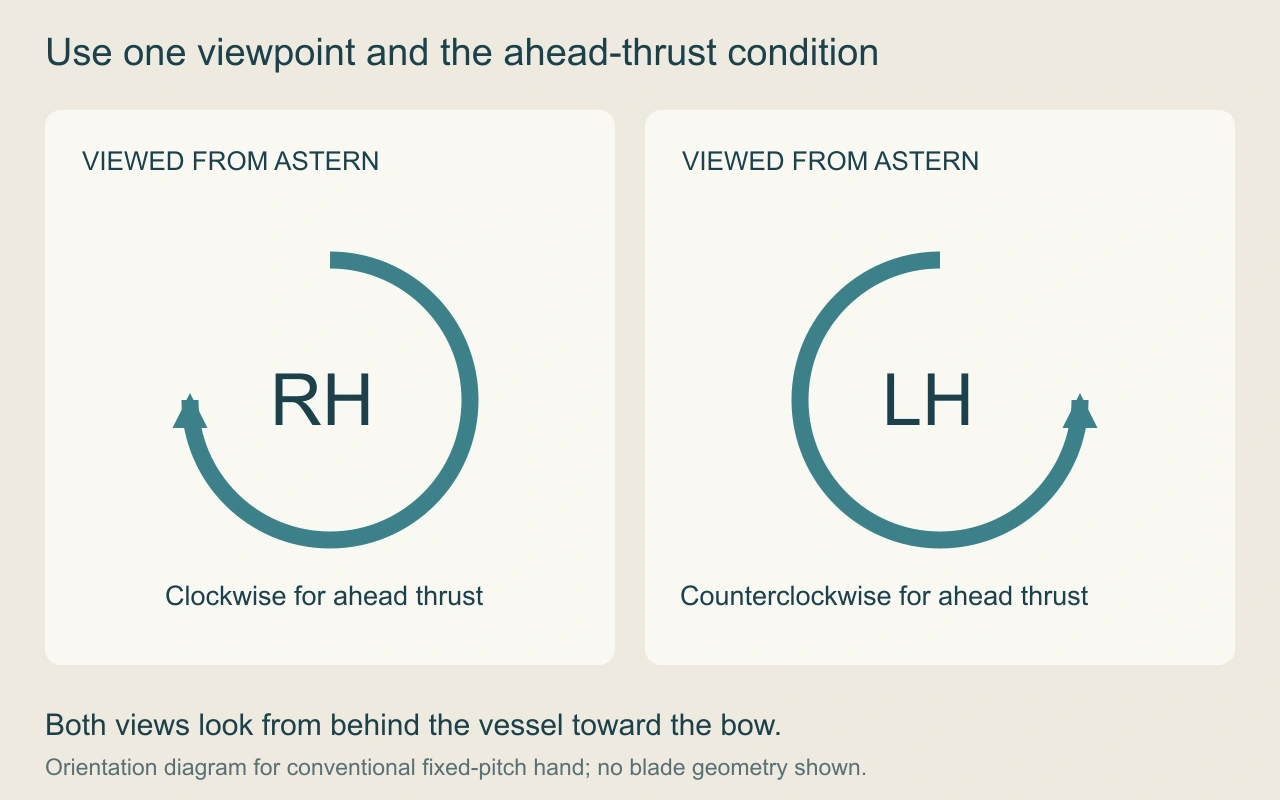
Read hand from astern, looking forward
Michigan Wheel's propeller FAQ identifies right- and left-hand rotation from behind the vessel looking toward the bow. Wärtsilä's rotation definition makes the operating condition explicit: the propeller is producing forward thrust.
On a small screen, scroll the table sideways.
| Under the same viewing and thrust conditions | Propeller hand |
|---|---|
| Viewed from astern looking forward; clockwise for ahead thrust | Right-hand, RH |
| Viewed from astern looking forward; counterclockwise for ahead thrust | Left-hand, LH |
The conditions in the left column do real work. “Clockwise viewed from the engine end” is a different observation from “clockwise viewed from astern.” Copying only the word clockwise between those records loses the reference that gives it meaning.
A reverse view does not create the opposite hand
A right-hand fixed-pitch propeller remains a right-hand component when it is photographed from the other side. The image changes; the blade handedness does not.
Michigan Wheel separately explains that turning a fixed-pitch propeller around does not convert it to the opposite hand. The opposite-hand propeller has different blade handedness. That is a manufacturing distinction, not a label to change after copying an otherwise unchanged part definition.
This is also why an unlabeled curved arrow is weak evidence for a repeat casting. It may describe an opposite viewing direction or a different operating condition. An arrow should be read with the drawing view and the stated condition, not used to override them.
Keep hand with the component definition
During a sourcing handoff, the useful record is the released propeller definition with RH or LH and the viewing convention stated together. A photograph can help identify the supplied part, but it should have its viewing side identified. If the photograph and drawing appear inconsistent, resolve the references before treating them as different hands.
For a custom fixed-pitch casting enquiry, carry that handedness note with the propeller drawing and state whether the requested delivery is a blank or a machined component. The fixed-pitch propeller casting page is the relevant product route. A clear hand definition prevents the enquiry from depending on which way someone happened to hold a sample for a photograph.