
PUMP IMPELLER ENGINEERING
Bronze Pump Impeller Castings: Which Surfaces Need Machining?
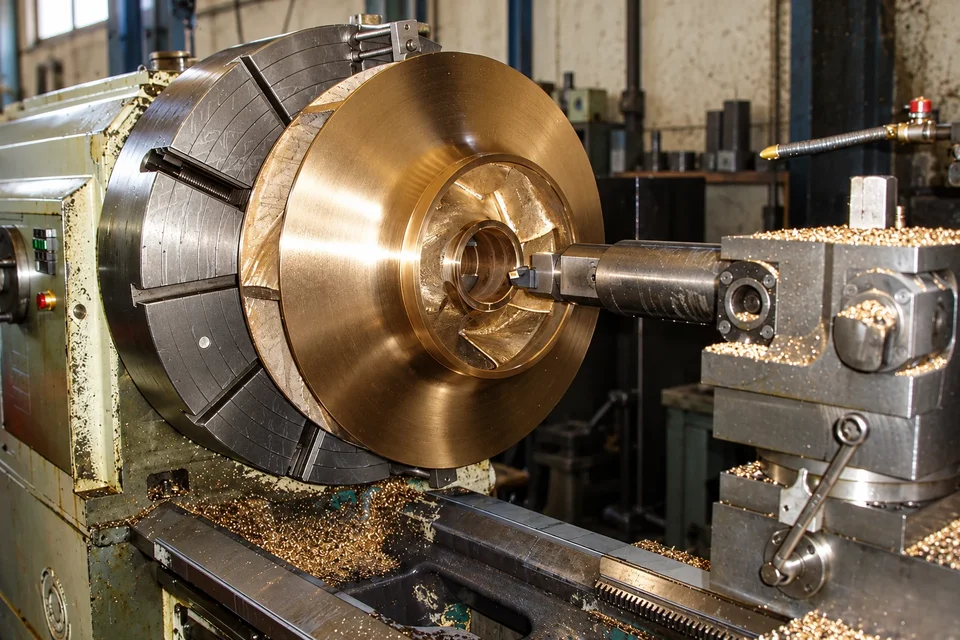
A bronze pump impeller has two very different kinds of surface: the passages that move liquid and the interfaces that locate the part on the shaft. A casting can form the curved vanes and shrouds, while the bore, locating faces and other drawing-defined fits need a separate finishing plan.
When buying bronze pump impeller castings, look past the turned outer face. Ask which surfaces are finished, which still carry machining stock, and how the finished features relate to the shaft axis. Those details distinguish a usable casting blank from a component ready for assembly.
Start with the shaft connection
Find the feature that centers the impeller on the shaft. Depending on the design, this can be a parallel bore, a tapered bore or another specified connection. Then identify what transmits torque and what holds the impeller axially. A keyway, thread, retaining nut and shoulder have different jobs; a drawing should show the features actually used by that pump.
A bore diameter by itself does not describe the whole fit. Read the bore size together with its tolerance, length, surface requirement and locating face. On a keyed design, the keyway dimensions and position belong with that connection. Pentair's C Series bronze pump specifications, for example, identify a keyed shaft connection. Other pump designs use other arrangements.
For a casting-only order, these are finished-part requirements, not an instruction to deliver the blank at finished size. The blank needs the stock required by the agreed machining plan. Removing that stock too early leaves the next operation with nothing to cut.
Match each surface to its job
Use the drawing to separate assembly interfaces from hydraulic surfaces. The following is a review map, rather than a list of features found on every impeller.
| Feature | What it does | What the drawing or supply scope needs to show |
|---|---|---|
| Hub bore and shaft connection | Locates the impeller and connects it to the rotating assembly | Finished fit, connection details and whether machining is included |
| Hub shoulder or locating face | Establishes axial position against its mating feature | Face location and its relationship to the bore axis |
| Wear-ring seat or running diameter, where fitted | Forms part of the controlled clearance at a rotating/stationary interface | Whether the dimension is for the impeller itself, a ring seat or the finished installed ring |
| Vane passages and inlet eye | Guide liquid through the impeller | Required geometry and any specified finishing or local dressing |
| Outer diameter | Defines the final impeller size used for the pump duty | Finished diameter and any approved trim, separately from casting stock |
The wear-ring distinction is easy to miss. A dimension for a ring mounting seat is not the running diameter after the ring is installed. Compare the section view and parts list before assigning the machining operation.
For an exposed-vane impeller, look at the vane-to-casing or wear-plate interface as well. For a closed impeller, check the specified shroud and ring interfaces. The open-versus-closed impeller guide explains why those clearances deserve different attention.
Why the reference axis matters as much as the diameter
Imagine a bore and an outside running diameter that each measure within their size limits, but are not centered on the same axis. Checking the two diameters separately would miss that relationship. Once assembled, the gap to the stationary part would vary around the circumference.
This is why a machined bronze impeller needs more than a list of diameters. The drawing needs to identify the reference features used to control the relevant relationships. Size, runout and face orientation answer different questions. A balance check answers another question again; it does not replace a dimensional check of the shaft fit or running surfaces.
On the drawing, mark the surfaces that locate the part, the surfaces that run close to stationary components, and the references used to inspect them. “Precision machined” does not tell the machine shop which relationship matters. A specified bore size, face location and runout requirement do.
A smooth exterior does not tell you what is inside
A closed impeller can have clean turned shrouds while its internal passages remain cast. A bright product photograph therefore says little about passage geometry or the condition of surfaces hidden behind the front shroud.
Read the passage requirements separately from the cosmetic finish. An intentional cast texture and an unwanted obstruction are different issues. If the drawing calls for a particular passage finish, edge treatment or local dressing, identify that area. A blanket request to “polish the whole impeller” leaves the actual hydraulic requirement unclear.
Delivery condition is also an established distinction in the casting market: Inoxyda, for example, describes impellers supplied raw, rough-machined or finish-machined. These terms describe stages of supply; none, on its own, defines every finished feature.
Keep hydraulic trimming separate from casting allowance
Machining stock is material left for a later manufacturing operation. Impeller trimming changes the final hydraulic component. Confusing the two can change the part you intended to buy.
KSB explains that reducing impeller diameter changes pump performance, and that the effect and permitted extent depend on impeller design. A replacement should therefore be made to the approved finished diameter, including the correct trim where applicable. Do not infer that dimension from a worn rim or treat extra diameter as a harmless allowance on a finished part.
If your order is for a blank, identify the approved finished drawing and the agreed blank dimensions separately. If it is for a machined component, identify the final drawing revision. That keeps the casting plan and the pump's operating geometry from being mixed together.
Put the supply boundary on the drawing
Mark the finished surfaces and the operations retained by your shop on one drawing. Add the alloy designation, quantity and revision. That is a more precise casting inquiry than a photograph captioned “complete bronze impeller.”
Zhiren supplies copper-alloy castings in as-cast or machined condition. See the pump impeller casting product page for the component information, then send the marked drawing for your required supply condition.