
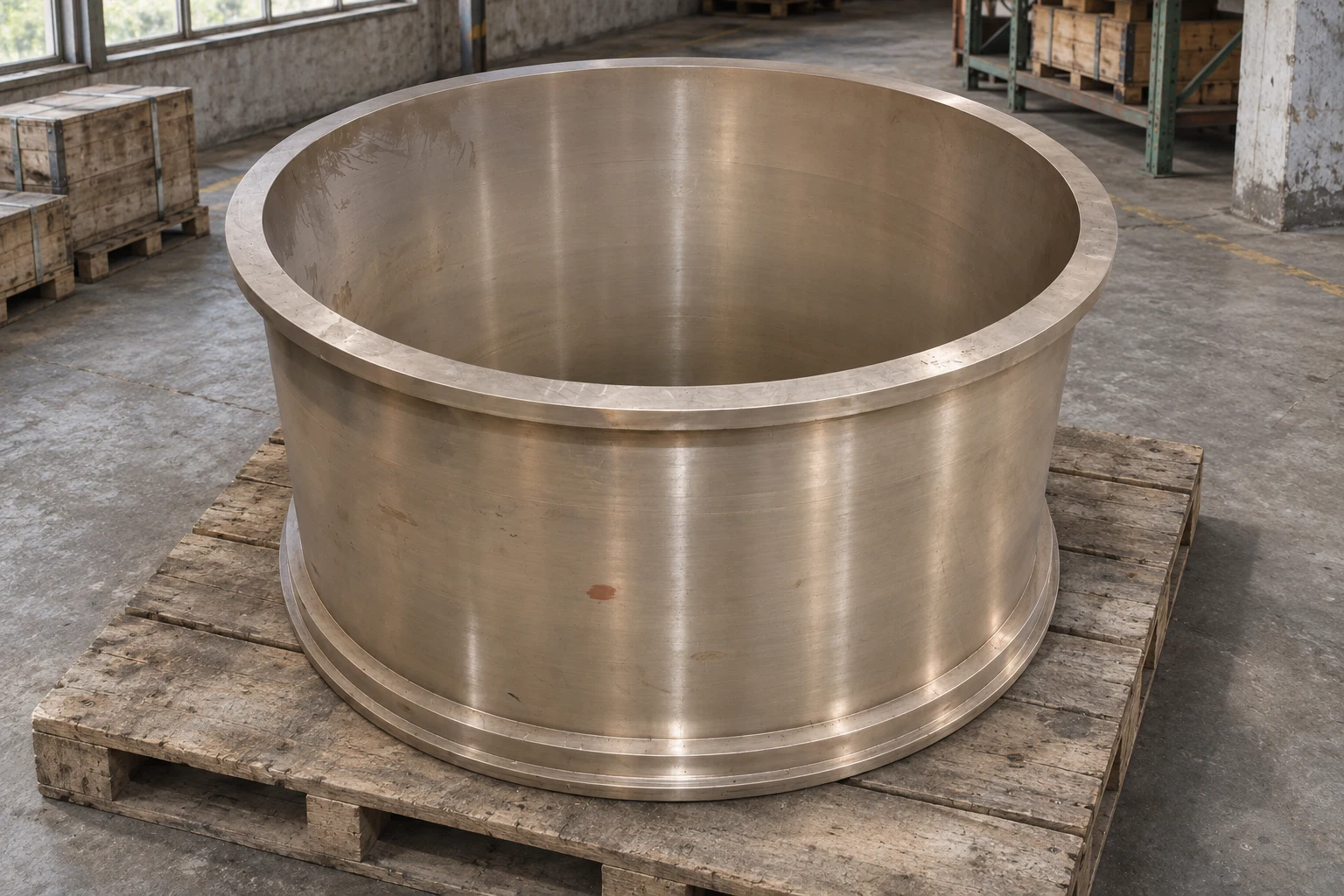
A flanged bronze bushing can have the intended barrel diameter and still stop before the flange reaches its support face. One place to examine is the transition between the barrel and flange: the root profile can meet the housing corner before the flat faces meet.
This is a local geometry question. Checking only the bore and outside diameter does not answer it.
Follow the contact around the corner
A flange projects from the end of the bushing's barrel. Where those surfaces meet, the actual part may have a rounded transition rather than an ideal sharp corner. The housing also has an entry profile and a face intended to support the flange.
AST Bearings' flanged-bushing mounting guidance specifically calls out interference at that root radius and the need to provide housing clearance. A US manufacturer's flange bushing description likewise identifies the integral shoulder as a locating feature. Those are separate surfaces to compare, even though they belong to one bushing.
In a local section, trace where the housing corner would lie as the flange approaches its intended support face. If the corner occupies the same space as the root transition, contact occurs there first. The barrel can match the cylindrical bore while the flange remains separated from its intended flat support.
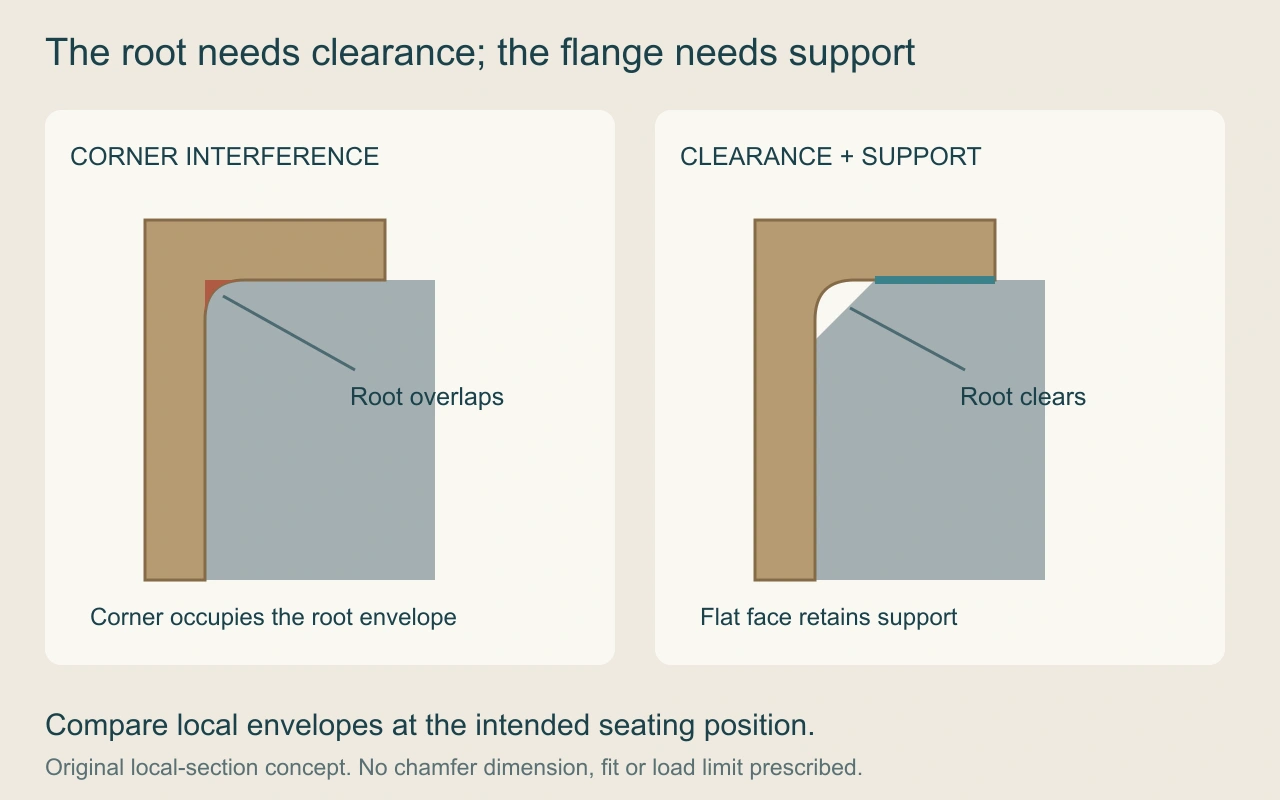
Clearance must leave a supported flange
Enlarging a chamfer is not an unlimited objective. AST's same guidance also identifies the need to support the flange where axial loading is involved. A corner relief and a support face therefore need to be considered together.
The comparison is between the actual root envelope, the housing entry and the remaining flat support. A nominal housing-bore dimension cannot describe all three. Nor does a flange-thickness measurement establish where first contact occurs at the inner corner.
The source's example dimensions are not a universal specification for a custom cast-bronze part. The released mating geometry determines what clearance and support are required in that assembly.
Show both parts in the local detail
For a component enquiry, include a section through the bushing flange and housing entry. Locate the intended support face and show the actual root form. This makes an interference question visible without turning it into an assumed bore-size error.
If the requested supply is a casting blank, distinguish its remaining machining stock from the finished root and seating surfaces. If it is a machined bushing, identify those finished features on the component drawing.
Continue through the flanged bronze bushing page with that mating detail and the requested delivery state. The useful starting point is the corner relationship: what must clear, and where the flange is intended to sit.