
PUMP IMPELLER ENGINEERING
Bronze Impellers for Seawater Pumps: Read the Wear Before Reordering
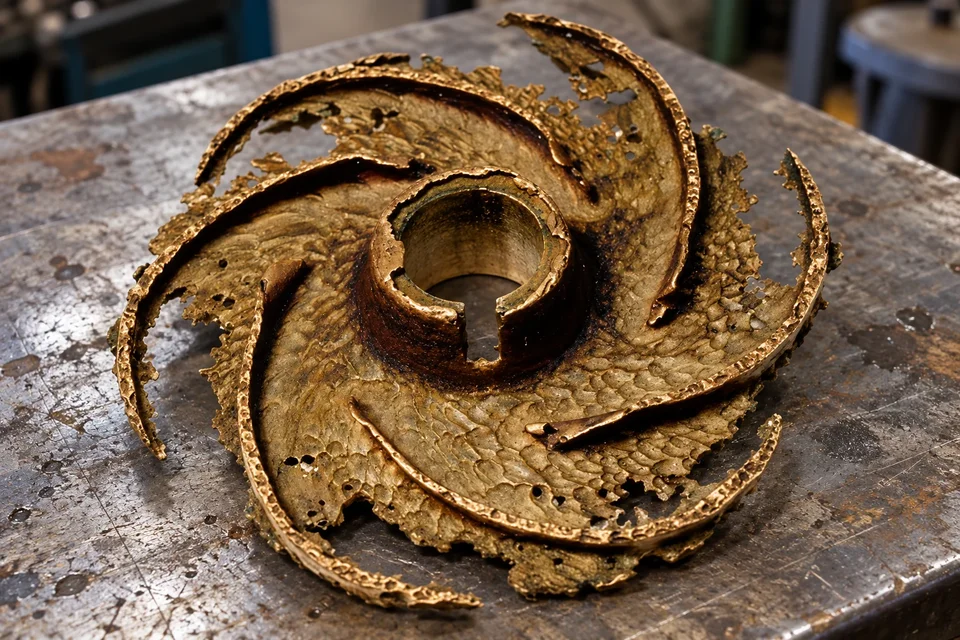
A worn bronze seawater pump impeller is useful evidence, but it is a poor master for a new part. Eroded vane edges, a worn running diameter or a damaged hub can all be copied into a replacement if the used component is treated as the original design.
Before reordering, separate the geometry to restore from the cause of material loss. An approved drawing can define the new vane profile and running dimensions. The wear investigation explains whether the next part will face the same suction restriction, abrasive intake or contact problem. Both belong in the replacement decision.
Record the part before removing the evidence
Photograph the inlet eye, both faces, the outlet edges and the shaft connection before aggressive cleaning. Include an overall view so that close-ups can be located on the impeller. Mark the rotation view and identify the matching casing or wear plate in the records.
Locate each damaged area on the overall photograph: the inlet side of a vane, a running band, a passage wall or an area under deposits. “Pits near the vane inlet” preserves an observation that an engineer can investigate. Calling the whole part “bad bronze” loses that information and jumps past the cause.
Retain the original part number, drawing revision and any known diameter trim with those images. The pump model identifies the equipment, while the drawing identifies the particular component ordered for it.
Pitting can point toward cavitation; it does not prove it
Vapor cavitation begins when local liquid pressure falls below vapor pressure. As the bubbles reach a higher-pressure region, they collapse. Repeated collapse close to a metal surface can remove material. Noise, rough running and declining head can accompany the process, as described in KSB's cavitation reference.
For an investigation, put the damage location beside the operating history. Check suction conditions, intake and strainer condition, liquid temperature, speed and the actual duty point. Compare the system's available suction head with the pump's requirements using the pump manufacturer's procedure.
A pitted surface can have more than one contributing mechanism. In seawater, repeated disruption of protective surface layers can also interact with corrosion. Replacing the impeller without investigating the operating conditions leaves that cause in place.
Abrasive wear asks a different set of questions
Sand and other hard particles remove metal by mechanical contact. Concentration, particle properties, impact conditions and relative velocity all affect the wear process. KSB's abrasion reference distinguishes this mechanism from cavitation.
Map scoured areas and thinned passage edges, then check the intake history for sediment-heavy operation, a damaged or bypassed strainer, or a change in duty. The location of wear and the record of what entered the pump are more useful together than either is alone.
Do not use a polished appearance as proof that the hydraulic shape is intact. A surface can become smoother while the vane profile or running diameter is being worn away. Compare the remaining dimensions with the approved drawing, rather than with another worn vane on the same part.
A worn running band is also a mating-part problem
An impeller does not work in isolation. Damage at a running surface calls for inspection of the corresponding stationary ring, casing face or wear plate. Fitting a new impeller against an already worn mating part does not automatically restore the intended gap.
KSB documents, for example, how shaft deflection under an unsuitable operating condition can cause impeller contact with a casing wear ring. Continued contact widens that clearance. The consequence for the replacement order is practical: check the assembly condition and the cause of contact before deciding which part to replace. See KSB's rotor and bearing planning discussion.
Measure and record both sides of the affected interface. Label worn measurements as worn measurements; put the specified new-part dimensions beside them, rather than silently replacing the design values with the dimensions found during dismantling. The open and closed impeller comparison shows where these interfaces differ by construction.
Seawater exposure is more specific than “corrosion resistant”
The exact alloy and the conditions at its surface matter. Copper-alloy seawater guidance distinguishes flowing service, local impingement and system design; it does not treat every copper alloy as interchangeable. The Copper Development Association's seawater system design guidance discusses pump casings and impellers separately because their local exposure differs.
Retain the specified alloy designation and available material records when investigating a failed bronze impeller. Color alone cannot identify the grade. Record deposits, shutdown periods and any known change in water condition alongside the operating data. If the investigation calls for a material change, make it an engineering revision with a stated reason rather than a substitution hidden inside a casting order.
| Observation to keep | Why it matters to the replacement |
|---|---|
| Missing or thinned vane edge | The used edge cannot establish the original profile |
| Worn ring or running diameter | A replacement needs the approved dimension and the mating-part condition |
| Pits, deposits or local scouring | Preserve location and service history for the failure investigation |
| A previously trimmed outer diameter | Recover the approved trim record rather than estimating from the worn rim |
| Damaged bore, keyway or locating face | Restore the specified shaft connection instead of copying the damage |
Reorder from the design, with the wear history attached
Use the approved drawing to define the replacement and the old part to explain what happened in service. If the drawing is incomplete, identify the missing design dimensions before treating the sample as production geometry. Keep any wear-related design changes under a new approved revision.
Zhiren's pump impeller casting product page is the starting point for a casting inquiry. Send the drawing, specified alloy, quantity and required delivery condition with the wear photographs. For a part in a shipboard cooling circuit, the seawater cooling application page provides the system context.