
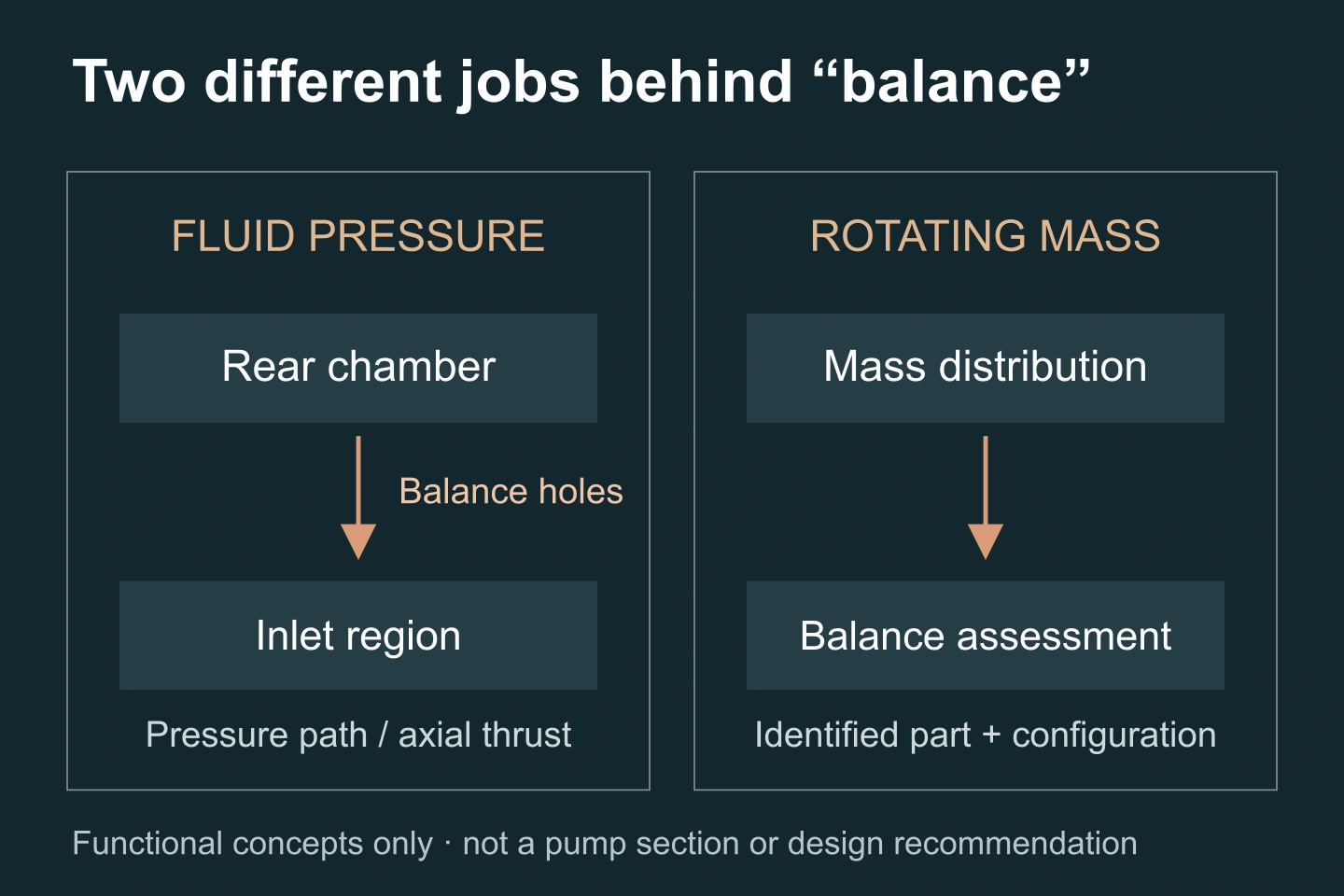
Small holes near an impeller hub can be easy to dismiss as manufacturing details. If they are impeller balance holes, they belong to a pressure-control path in the pump. Their job is different from the rotating-mass assessment recorded on a dynamic-balance report.
That distinction matters when ordering a bronze replacement. “The new part has been balanced” does not answer whether its hydraulic holes have the right geometry, and a ring of holes does not establish a dynamic-balance result.
Follow the pressure path
Fluid pressure acts on the impeller's shroud surfaces and contributes to force along the shaft. The pressure distribution on the two sides matters; the outside silhouette alone does not describe it.
KSB's balancing-hole definition identifies their purpose as reducing axial thrust through pressure balancing. In the single-stage arrangement described in its axial-thrust guide, holes provide a connection toward the lower-pressure inlet region from a chamber behind the impeller.
The holes work within a surrounding arrangement of flow paths and restrictions. A closed hole, a different connection or a changed opening therefore concerns the hydraulic design, not just the amount of metal in the casting. This does not mean every impeller needs holes, or that holes eliminate all axial thrust.
Dynamic balancing asks a different question
Rotating-mass balancing addresses unequal mass distribution about the rotor's axis. Its result must be interpreted for the component or assembly that was assessed.
Compare the questions side by side:
On a small screen, scroll the table sideways.
| Question | Relevant evidence |
|---|---|
| Does the pressure-balancing path match the impeller design? | Section or controlled model showing the holes, their endpoints and applicable geometry |
| Does the assessed rotating part meet its specified balance requirement? | The applicable balance result tied to the identified part and configuration |
Neither row replaces the other. A component can have a correct hole pattern without a supplied balance record. A balance record can describe a part whose hydraulic features still need dimensional verification. Our impeller balance-record guide explains what the second kind of evidence covers.
A threaded hole can still carry a hydraulic function
Do not classify every tapped hole as a permanent fastener location. Vertiflo's Series 629/636 instructions describe threaded balance holes in one arrangement and a different untapped condition in the other. That named example shows why thread appearance alone cannot settle a hole's role.
Trace the feature through the drawing. Does it connect two fluid regions? Where does it emerge? Does the component definition give it another function as well? A front photograph may show an opening without showing its destination.
The point is to identify the existing design, not to copy another pump's service procedure or add threads to a new casting. The hole's full definition controls manufacture.
Keep the feature when comparing replacement castings
When two candidate impellers differ, identify the specific difference before calling one equivalent. A missing hole is not automatically an omitted balance correction. A similar circumferential pattern does not establish the same internal connection or opening size.
The surrounding features matter too. KSB describes axial-thrust arrangements using side clearances and other designs using back vanes. Similar overall diameters do not establish that those arrangements are interchangeable. The wear-ring clearance guide explains why a running gap must also be understood as a relationship between mating parts.
Keep hole count, size, position and endpoints within the released component definition. Where a sample and a drawing disagree, preserve that discrepancy for the design owner to resolve rather than quietly filling, omitting or enlarging the feature during manufacture.
For a replacement through Zhiren's pump impeller casting page, provide the section that shows where the holes lead and the required casting or machined delivery state. That makes the hydraulic feature visible in the supply discussion alongside the outside geometry.