
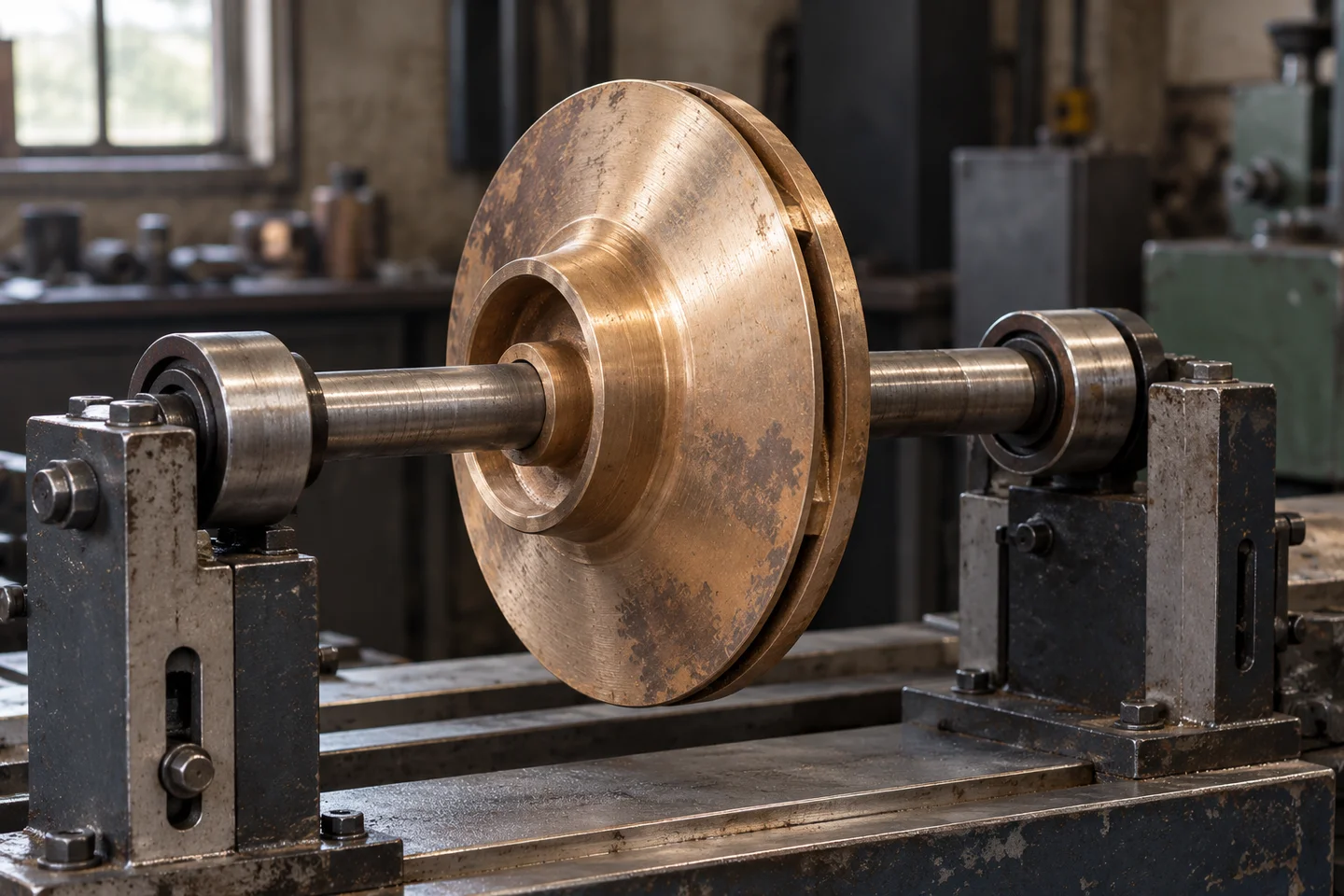
The bore is within tolerance. The machined face runs true. A balance report is attached. These are three useful pieces of information, but they do not prove the same thing.
For a buyer ordering a machined bronze impeller, pump impeller balancing is a mass-distribution requirement. The first question is which physical configuration the result describes: the casting blank, the finished impeller, or a larger rotating assembly.
That distinction matters when the part still needs a keyway, diameter trim or another material-removal operation after the reported check.
A true-running surface can still carry an uneven mass
Runout describes how a surface varies relative to a reference axis during rotation. Mass balance concerns how the rotor's mass is distributed about its rotation axis. A surface measurement does not reveal every variation inside the casting.
Consider an intentionally simplified example: an otherwise balanced disc carries an extra 2 grams at a radius of 100 millimeters. That addition represents 200 gram-millimeters of unbalance, calculated as mass multiplied by radius. It need not change the bore diameter or move the machined face outside its dimensional limit.
Those numbers are illustrative, not a permitted limit or a Zhiren test result. The point is that a dimensional inspection and a balance evaluation answer different questions. A report that lists only bore size and face runout leaves the mass-balance question open.
Static and dynamic balance are different tasks
KSB's balancing explanation distinguishes single-plane static balancing from two-plane dynamic balancing. Static balancing addresses the mass center relative to the shaft axis; two-plane balancing also addresses the unbalance couple.
Picture equal extra masses near opposite ends of a rotor, on opposite sides of the axis. Their combined mass center can lie on the axis while their axial separation still produces a couple during rotation. This is why a satisfactory static check cannot automatically substitute for a specified two-plane evaluation.
Do not choose the method from the word “bronze” or from a single photograph. Follow the applicable pump or rotor specification, including its defined configuration and acceptance criterion. A grade used for another impeller is not automatically the correct requirement for yours.
Read the configuration before the pass statement
The report needs to connect a measured result with an identified part and a defined setup. A short statement such as “balanced” is difficult to interpret if that connection is missing.
On a small screen, scroll the table sideways.
| Record detail | What the buyer needs to resolve |
|---|---|
| Part identity and revision | Does the result belong to this component definition? |
| Delivery state | Were final machining and the approved diameter trim complete? |
| Rotor configuration | Was the impeller checked alone or with other rotating parts? |
| Mounting and key treatment | What fixture and key/keyway convention did the evaluation use? |
| Acceptance and result | What criterion, units and residual result support the disposition? |
These are record-reading questions, not a universal report form. The applicable specification controls the required fields and method.
The equipment maker Hines describes impeller balancing systems with tooling for different bores, allowance for tooling effects, key/keyway treatment and tolerances related to component weight and usage speed. Those details explain why setup information belongs with the result.
Put the balance check after the work it is meant to cover
Suppose an impeller was evaluated before its final outside diameter was machined. The report may correctly describe that earlier part. It does not, by itself, describe the later configuration.
The practical handoff is to identify the remaining material-removal operations and have the responsible party determine the required final evaluation. Do this before dividing the order between a foundry, machine shop and assembly team. Otherwise, each supplier can complete its own scope while the finished configuration has no corresponding acceptance record.
For the related dimensional boundary, our guide to casting and machining surfaces explains why a casting blank and an assembly-ready impeller are different deliveries.
Balance correction also needs a defined boundary. A permission to remove mass is not permission to alter every vane, shroud, fit or passage. Keep the allowed correction locations and any dimensional restrictions with the applicable manufacturing instructions rather than leaving the operator to infer them from appearance.
Keep component acceptance separate from the installed pump
A component balance result addresses its stated balance task. It does not establish the installed pump's flow, head, clearances or overall vibration condition. It also cannot replace dimensional checks on the shaft connection.
Keep the evidence in separate, connected records: the drawing controls the component definition; inspection records address the required features; the balance record addresses its specified rotor configuration. Our first-article inspection guide shows how to check whether a result actually answers the requirement beside it.
Buying the casting and machined part
Zhiren supplies custom copper-alloy castings in as-cast or machined delivery states. For an impeller project with a balance requirement, start with the pump impeller casting supply page and identify the required delivery state and who owns final balance acceptance. That gives the casting and machining scope a clear handoff without treating a general “machined” description as a complete acceptance specification.