
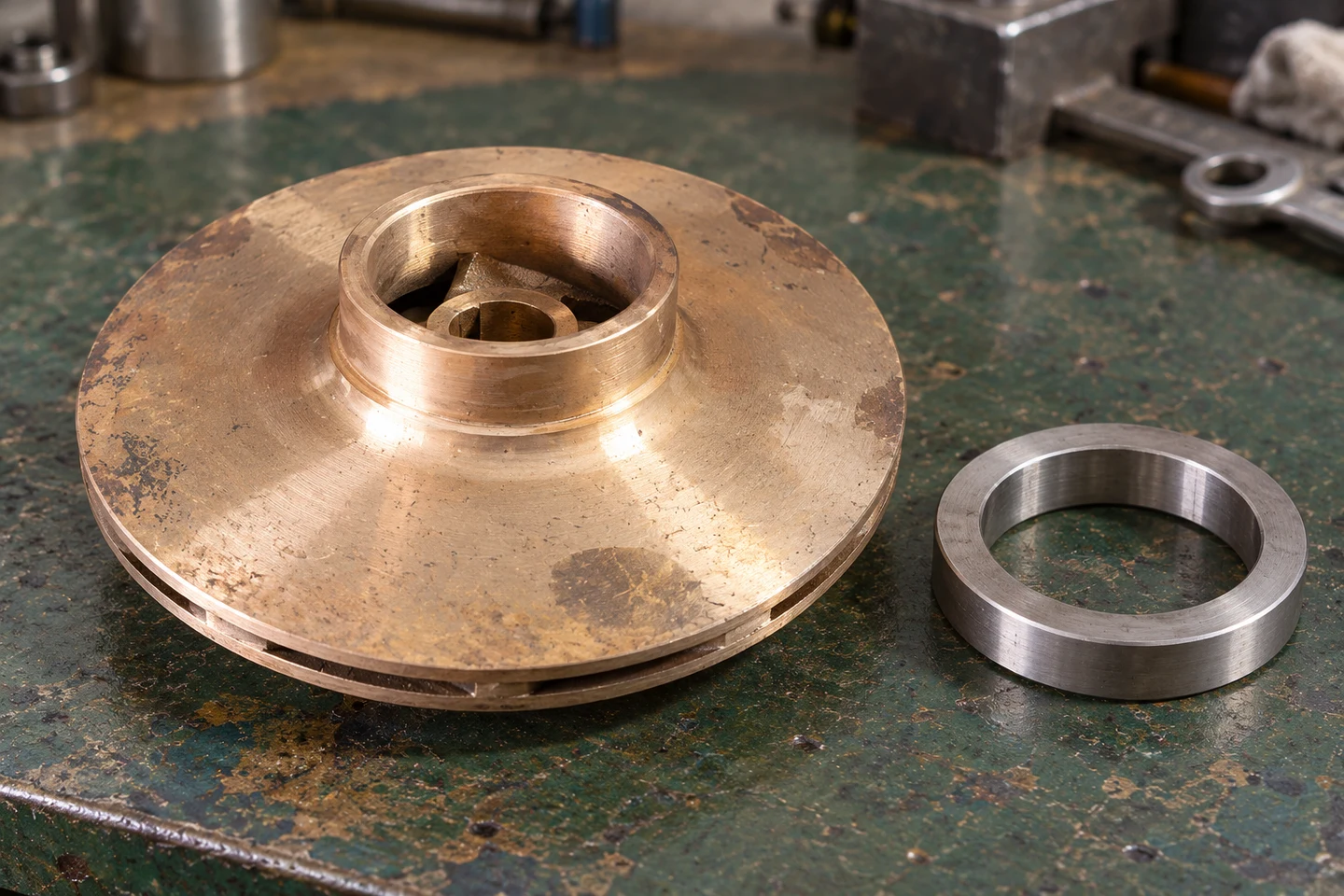
A replacement bronze impeller arrives to the specified drawing. The pump is rebuilt with its existing casing wear ring. The impeller can be correct and the assembled running clearance can still be wrong.
The reason is straightforward: pump wear ring clearance is a relationship between two surfaces. Replacing the rotating surface does not establish the condition of the stationary one.
For an order that includes finished running surfaces, identify both sides of that relationship before treating “new impeller” as a complete restoration of the gap.
First identify which ring rotates
In the ringed construction discussed here, the casing wear ring stays with the casing. The impeller wear ring is attached to the impeller and rotates with it. The running clearance lies between the casing ring's inside surface and the rotating ring's outside surface.
Xylem's e-XC manual, section 6.1.1, identifies these two parts and calls for checking the gap at several positions because wear may be uneven. This is a useful construction example; its replacement limits belong to that pump family.
Read the section drawing for the actual pump. Do not order an extra rotating ring simply because another impeller photograph has one. If the supplied drawing defines the running surface directly on the impeller, follow that definition rather than silently converting it to a different assembly.
The ring mounting fit is not the running clearance
For a separate impeller ring, there are two different interfaces:
- Ring to impeller seat: the interface that positions and retains the ring on the rotating component.
- Rotating ring to casing ring: the gap across which the rotating and stationary parts pass each other.
The first pair assembles together; the second pair needs its specified running separation. A correct ring bore or seat dimension does not establish the final running outside diameter.
This distinction matters in a purchase order. “Impeller supplied with wear ring” can leave different finishing states unresolved: a loose ring, an installed ring awaiting finishing, or an assembly with its final running surface machined. Name the required state rather than leaving it inside the word “with.”
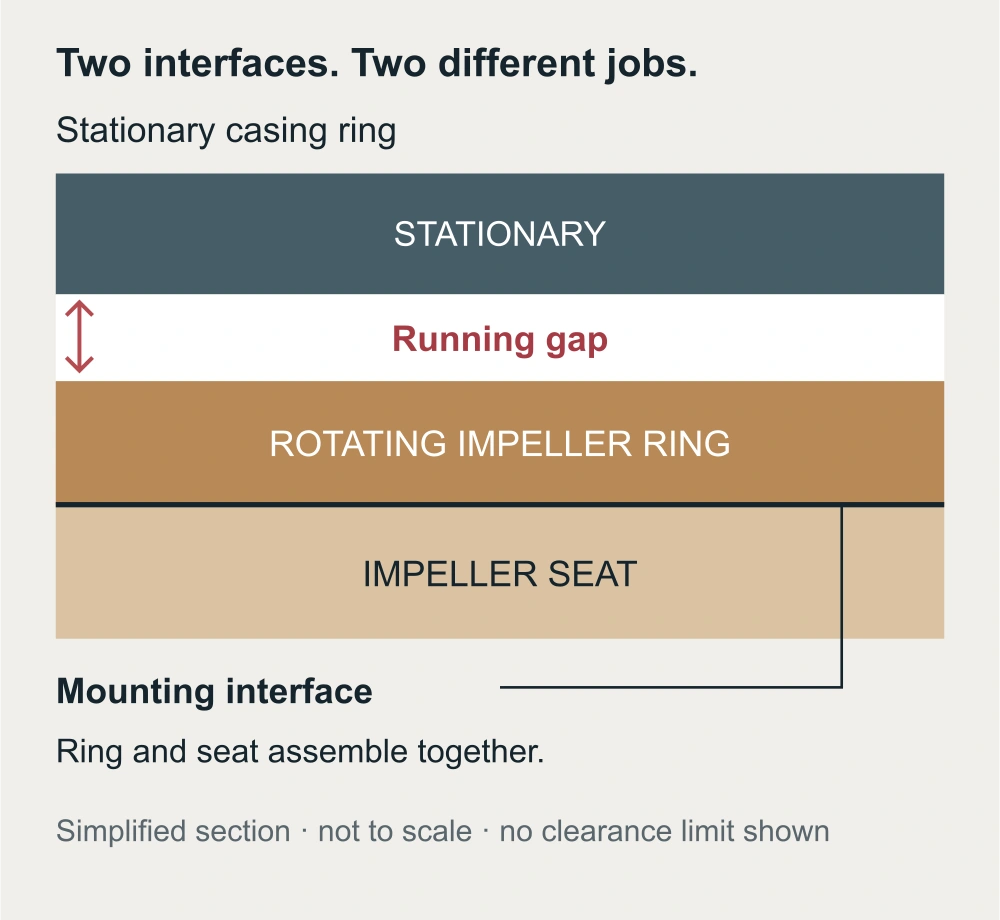
Original explanatory diagram; not to scale. No fit or running-clearance limit is specified.
A diametral number is twice the ideal radial gap
For concentric circular surfaces, the dimensional relationship is:
Diametral clearance = stationary inside diameter − rotating outside diameter.
Radial clearance = diametral clearance ÷ 2.
Consider a fictional pair with a stationary inside diameter of 4.012 inches and a rotating outside diameter of 4.000 inches. The difference is 0.012 inches on diameter, giving 0.006 inches radially in the ideal concentric case.
These dimensions illustrate the convention only. They are not a recommended gap, a production tolerance or a measured Zhiren part.
If a drawing note says “0.012 clearance” without stating its convention, the two interpretations are materially different. Resolve the note against the applicable pump documentation rather than selecting whichever value looks familiar.
The retained ring can defeat the new-part calculation
Suppose the rotating outside diameter in that same hypothetical example remains 4.000 inches, while the stationary bore is actually 4.020 inches. The diametral difference becomes 0.020 inches, or 0.010 inches radially in the ideal concentric case. A new rotating part did not make the retained bore smaller.
Even that arithmetic is only a starting point. Two diameter values do not describe eccentric positioning, taper, out-of-roundness or a locally worn area. Nor does an average gap prove that the tightest location has the required separation.
Record the relevant dimensions and locations using the pump's inspection method. If one mating component will remain in service, its measured condition belongs in the replacement decision. A worn sample can show what is present; it does not automatically define the intended new-part geometry.
Why “machine it tighter” is an incomplete answer
Running gaps provide paths for internal leakage. KSB's internal-leakage reference explains that the flow depends on the pressure difference and the path's geometry and surface condition. That is why the clearance matters hydraulically.
It does not follow that the smallest gap a shop can machine is the best operating gap. KSB's clearance discussion describes construction and operating factors that affect selection. Keep the pump-specific requirement; do not replace it with a general machining capability number.
For the difference between a running-surface diameter and the hydraulic outside diameter, see our replacement impeller trim-diameter guide. They are separate features with separate purposes.
Define the replacement as a mating-pair task
For a drawing-defined impeller order, identify the stationary mating feature, the required rotating running surface and the supplied ring's finishing state. If the stationary part is being retained, use its verified condition when resolving the final pairing.
Zhiren's pump impeller casting page is the starting point for custom as-cast or machined supply. Send the section detail showing the mating surfaces and the delivery state you need. Our casting and machining guide explains how those final interfaces differ from stock left on a casting blank.