
“Closed bronze impeller” leaves a basic identification question unanswered: does liquid enter from one side or both sides?
The distinction changes the component being ordered. Single suction versus double suction concerns the impeller's fluid entries. It does not tell you the number of stages in the pump, and neither label is a substitute for the axial geometry of a replacement part.
Look for the fluid path around the shaft bore
The impeller eye is an inlet to the vane passages. The shaft bore locates the component on its shaft. A bore visible from both ends is not, by itself, evidence of two fluid entries.
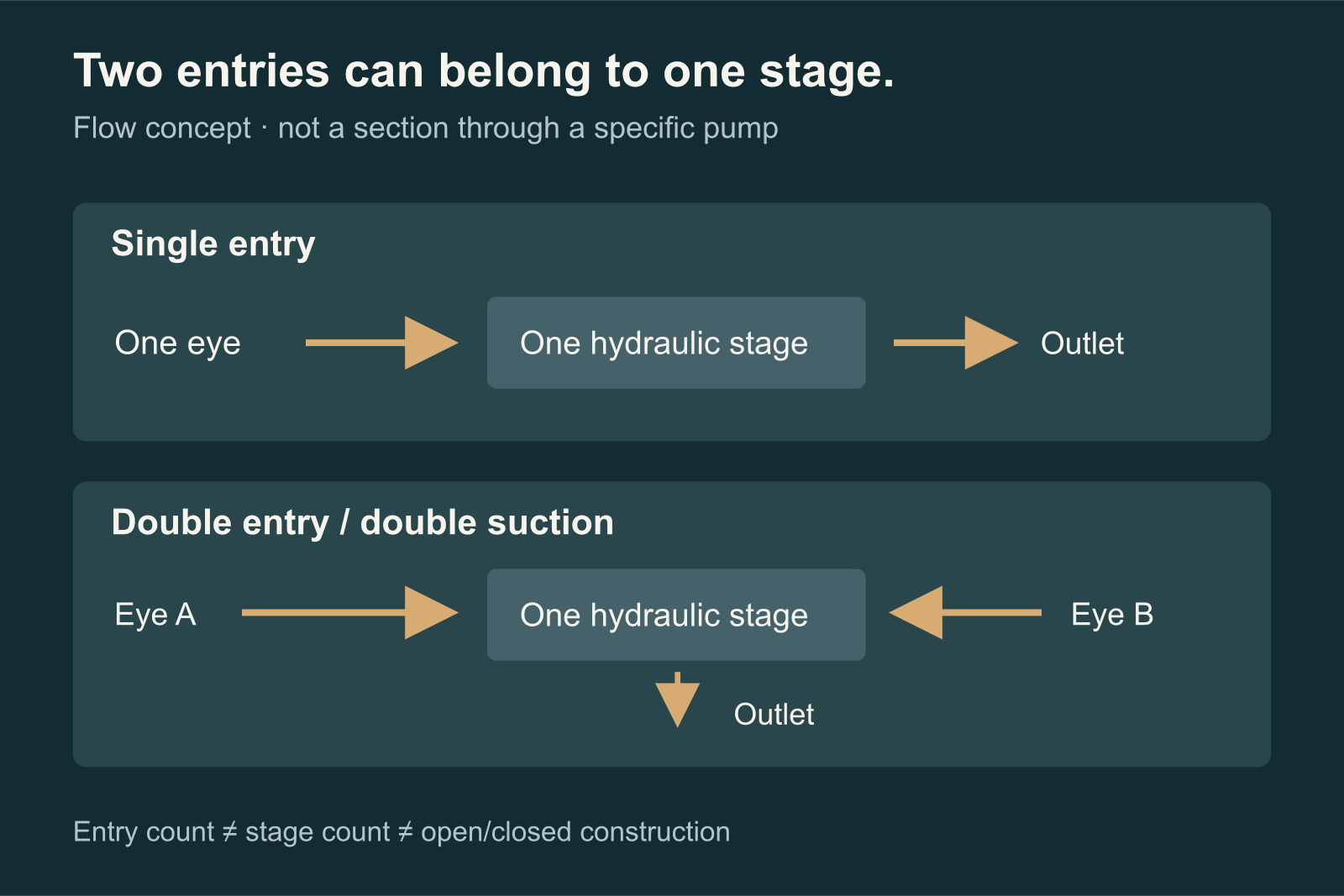
For a single-entry impeller, fluid enters the vane passages from one side. A double-entry impeller has a suction entry on each side, as defined in KSB's impeller lexicon. In the component comparison here, double entry is the two-sided arrangement commonly described in US pump specifications as double suction.
Trace the opening into the vane passages. An axial section is especially useful because it separates the shaft connection from the surrounding hydraulic passage. If only external photographs are available, views of both sides reveal more than two photographs taken from slightly different angles on the same side.
Two entries can belong to one stage
Pentair Aurora's 410 Series engineering specification provides a concrete example: an enclosed double-suction bronze impeller in a single-stage pump.
That combination is entirely consistent. The two entries admit flow from opposite sides of the impeller. They are not two successive stages through which all the liquid must pass in sequence. KSB's impeller arrangements illustrate entry count and stage arrangement separately.
The words “double suction” therefore do not justify calculating twice the pressure or selecting a replacement from an unrelated two-stage pump. Identify the pump arrangement and component definition rather than trying to infer performance from the word double.
Closed construction is a separate description
Open or closed describes how the vane passages are shrouded. Single or double entry describes how liquid is admitted. These are different features of the same component.
On a small screen, scroll the table sideways.
| Description | What it identifies | What it leaves unresolved |
|---|---|---|
| Closed or enclosed | Shrouding around the vane passages | Whether admission is from one side or both |
| Single or double suction | Suction-entry arrangement | Stage count and the complete mounting geometry |
| Single-stage or multistage | Hydraulic stage arrangement in the pump | The detailed definition of an individual replacement casting |
Pentair Fairbanks Nijhuis lists enclosed construction, double suction and a dynamically balanced impeller as separate features. This is a useful way to read a specification: retain each descriptor instead of allowing one familiar term to stand in for the rest.
The open-versus-closed impeller guide explains the shroud distinction in more detail.
Carry that identity into the replacement drawing
Once the entry arrangement is clear, compare the full axial section: eye geometry, overall width, hub extension and the shaft connection. A matching outside diameter establishes only one dimension. It does not show that the two parts occupy the same space or connect to the same assembly features.
Keep the rotation note tied to its viewing end as well. Turning the part over changes the view; it does not create a different released design. The impeller rotation guide explains how to keep that reference explicit.
For a custom order through Zhiren's pump impeller casting page, provide an axial section or views showing both suction sides, plus the required casting or machined delivery state. That identifies the component to be manufactured without asking the foundry to infer a pump redesign from a front photograph.