
Two impeller proposals can both say “use a core” and describe different manufacturing routes. One refers to an insert inside the wax pattern. The other refers to a refractory body that remains in place while metal surrounds it.
For a closed impeller passage, the useful comparison is what occupies that space at each stage. The finished inlet photograph cannot answer it.
A soluble insert does its job in the wax
A soluble wax core provides an internal shape around which the pattern wax is formed. The insert is then dissolved out of the wax pattern. The opening it leaves must subsequently be represented in the refractory mold arrangement that defines the metal casting.
The Investment Casting Institute's wax-pattern atlas, sections 2 and 3, distinguishes soluble cores from ceramic cores and emphasizes complete removal of soluble material. Paramelt's soluble-wax explanation describes formulations made for this dissolution step. These are process descriptions, not a single recipe for every impeller.
Removing a soluble insert and removing the main wax pattern are different events. The insert first creates the hollow region in the pattern. Later wax removal creates the space that the metal will fill. Mixing those events makes it difficult to explain which material defines the eventual passage wall.
A ceramic casting core stays through the pour
A preformed ceramic core has another job. It occupies the internal region during casting, withstands molten-metal exposure and is removed after solidification. The ICI's investment-casting process paper, in its ceramic-core discussion, identifies heat resistance and subsequent removal as linked requirements.
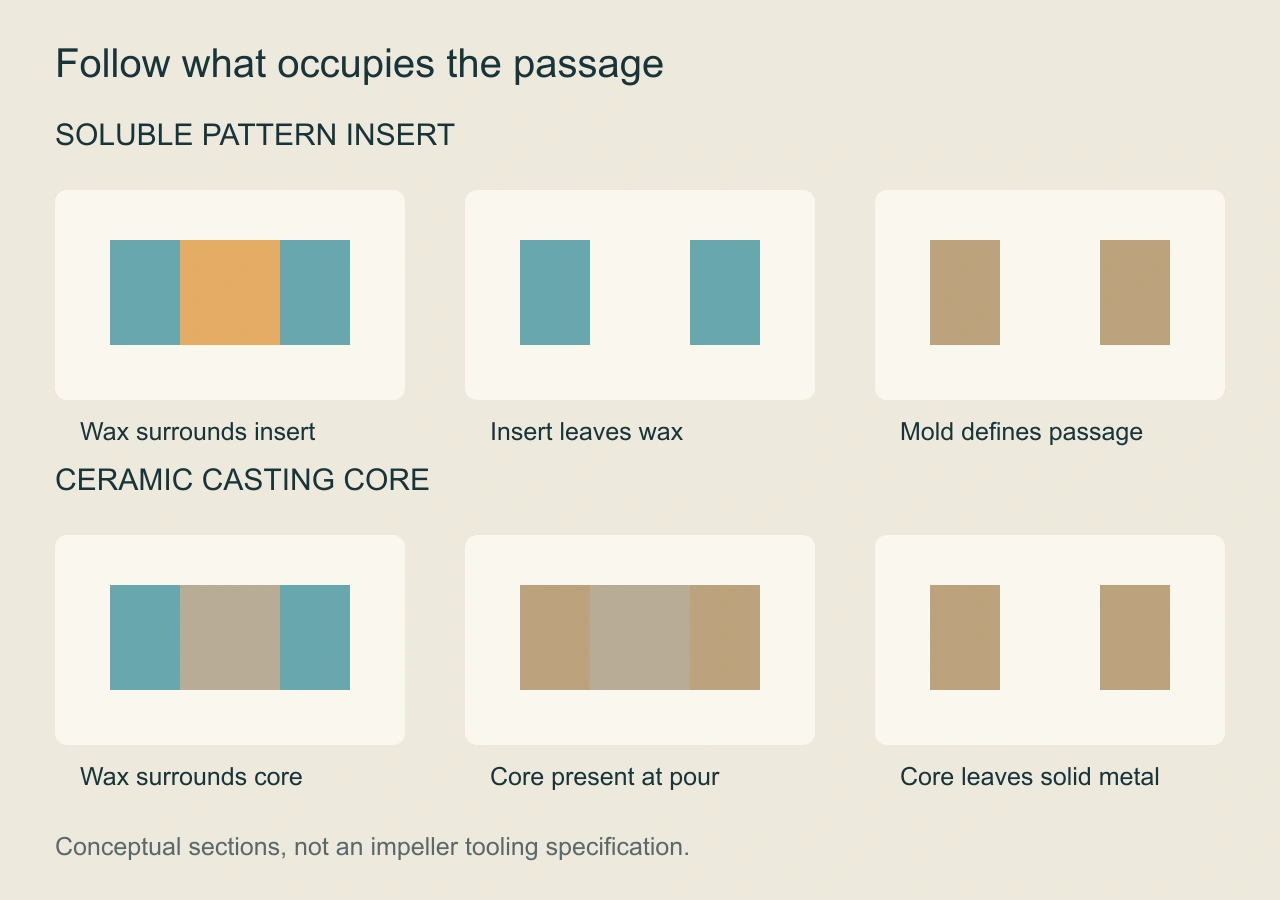
The phrase “core removal” therefore needs an object and a stage. Dissolving a pattern insert is not the same operation as extracting refractory material from a solid metal component. Access that works for one step does not establish that the other step has been resolved.
Compare the proposal using one passage section
Choose a section that shows the passage from the eye toward its outlet, including the surrounding vanes and shrouds. Follow that same section through the proposed sequence:
- During wax injection, identify the insert and the wax around it.
- Before pouring, identify the refractory surface that will bound the passage.
- After solidification, identify what must leave and the available access.
This comparison exposes a missing step without forcing a tooling choice from a product name. A cavity that looks open in one view can still contain a region hidden behind a shroud in another. The internal-passage inspection article follows the separate question of observing the finished result.
Core selection also does not settle how the main wax pattern leaves its injection die; that is the wax-tool release problem. Keeping these questions separate prevents one process label from being treated as a complete manufacturing plan.
When discussing a custom impeller through the impeller casting product page, include the section that exposes the enclosed region and its openings. It makes the intended passage clear before the conversation turns to the method used to form it.