
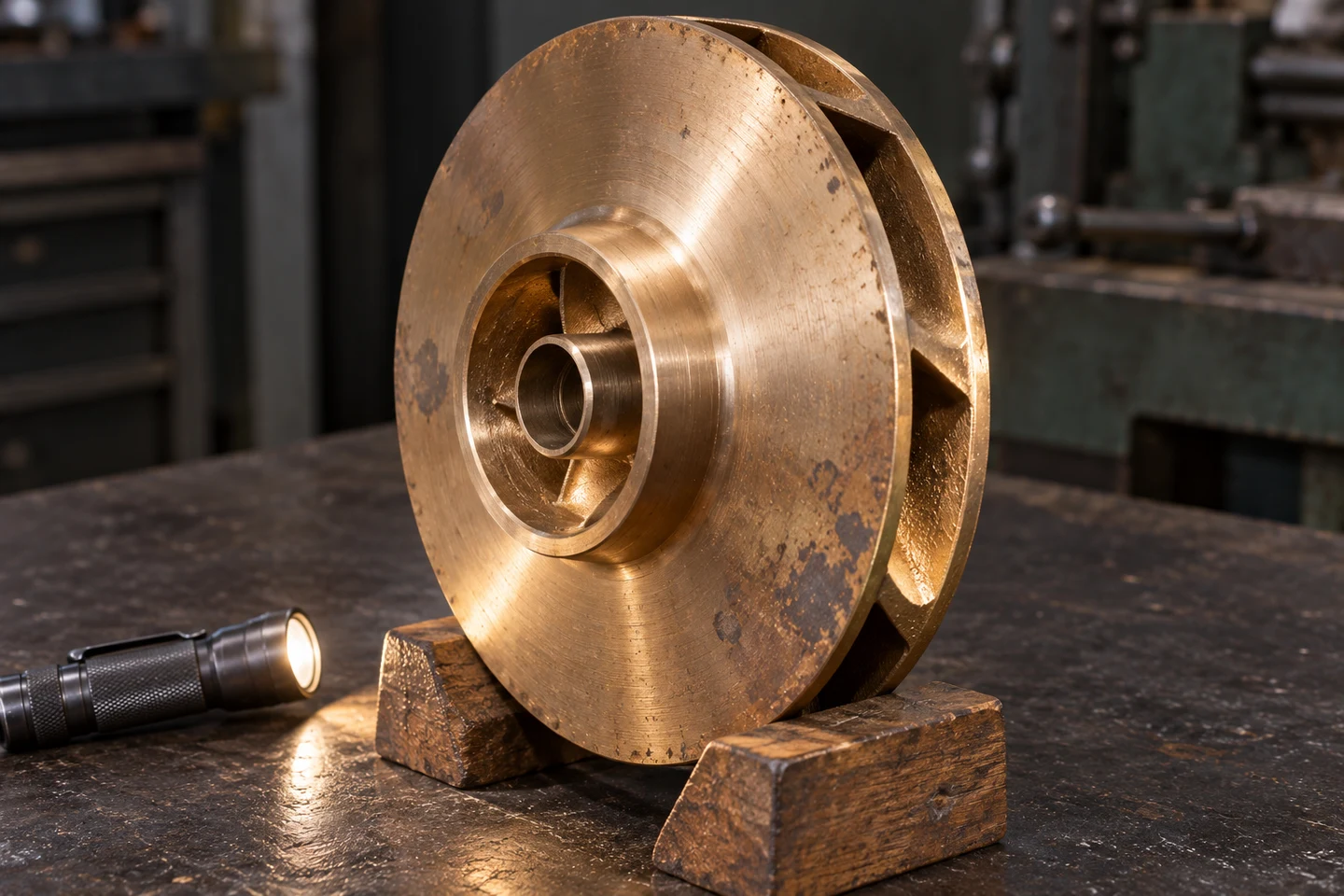
The front face looks clean. The inlet eye is open. Light reaches several vane edges. That is a useful view of a closed bronze impeller, but the liquid's route continues behind the shroud and around the curved passages.
For closed impeller inspection, separate three questions: Is the passage the required shape? Is anything obstructing it? What is the condition of the surface being examined? They are related, but one photograph does not answer all three.
This matters when buying a new casting. A well-machined bore and correct outside diameter can coexist with an internal channel that has not been adequately reviewed.
The inlet and outlet are only the ends of the waterway
In a closed construction, the vanes sit between front and rear shrouds. The eye provides access from the inlet side; the openings around the rim show the outlets. The curved walls and shrouds restrict the view between them. KSB's impeller reference illustrates these construction features.
An image taken through the eye may show the start of a channel without showing its middle. A rim photograph may show a clear exit without showing what lies around the bend. Seeing both ends is useful, but it does not automatically establish continuous coverage between them.
Compare the supplied geometry with the appropriate section views or controlled model, not just a front silhouette. Two castings can share the same external envelope while their internal passages differ.
Start with the kind of condition you are looking for
Geometry: was the waterway formed as defined?
The drawing or model defines the passage boundaries: the vane surfaces, shrouds and transitions between inlet and outlet. External hub measurements do not establish those boundaries.
A local obstruction made of cast metal is different from a loose particle. The Investment Casting Institute's core-breakage entry describes a metal fin where a ceramic core has fractured; it also identifies missing wall metal as a possible appearance when breakage and shift occur. That mechanism applies to castings made with ceramic cores. It is not a diagnosis to assign to every dark region in an impeller photograph.
The practical distinction is what the finding means for the component definition. Cleaning away loose residue and removing part of a cast vane or wall are different operations. Do not turn a channel-shape problem into an informal cleanup instruction.
Obstruction: is material occupying the intended passage?
On a newly manufactured casting, remaining process material can be an access and cleaning issue. It needs to be distinguished from the metal geometry around it.
An April 2026 question published by the Investment Casting Institute describes a foundry's difficulty removing ceramic cores from impeller vane openings, followed by borescope inspection. It is a specific manufacturing example of why internal access deserves attention. It does not establish one cleaning method for every alloy or impeller.
For purchasing, define the required supplied condition and its verification. A later photo that looks brighter does not, on its own, explain what was removed, whether all relevant areas were reached or whether the passage geometry was preserved.
Surface condition: what does the image actually show?
Shadow, reflection, casting texture and an actual discontinuity can produce different appearances as the viewing angle changes. A dark patch should be documented and examined, rather than labeled from its color alone.
ASNT's visual-testing overview distinguishes direct viewing from viewing through optical aids and describes how surface preparation, lighting and access affect examination. A scope extends access; it does not remove the need to know where it is looking.
A visual image is also not automatically a dimensional measurement. If an acceptance question concerns channel size or wall geometry, the evidence needs a suitable dimensional basis. If it concerns internal metal soundness, that is a different question again; our machining-exposed porosity guide explains why a surface opening cannot describe every hidden cavity.
Build coverage around passages, not a pile of photographs
Consider an illustrative review in which a passage has an inlet image and an outlet image, but no usable view of its mid-length region. Calling that passage “covered” hides the missing evidence. The useful record identifies the gap so the responsible reviewer can decide what additional access or evidence is needed.
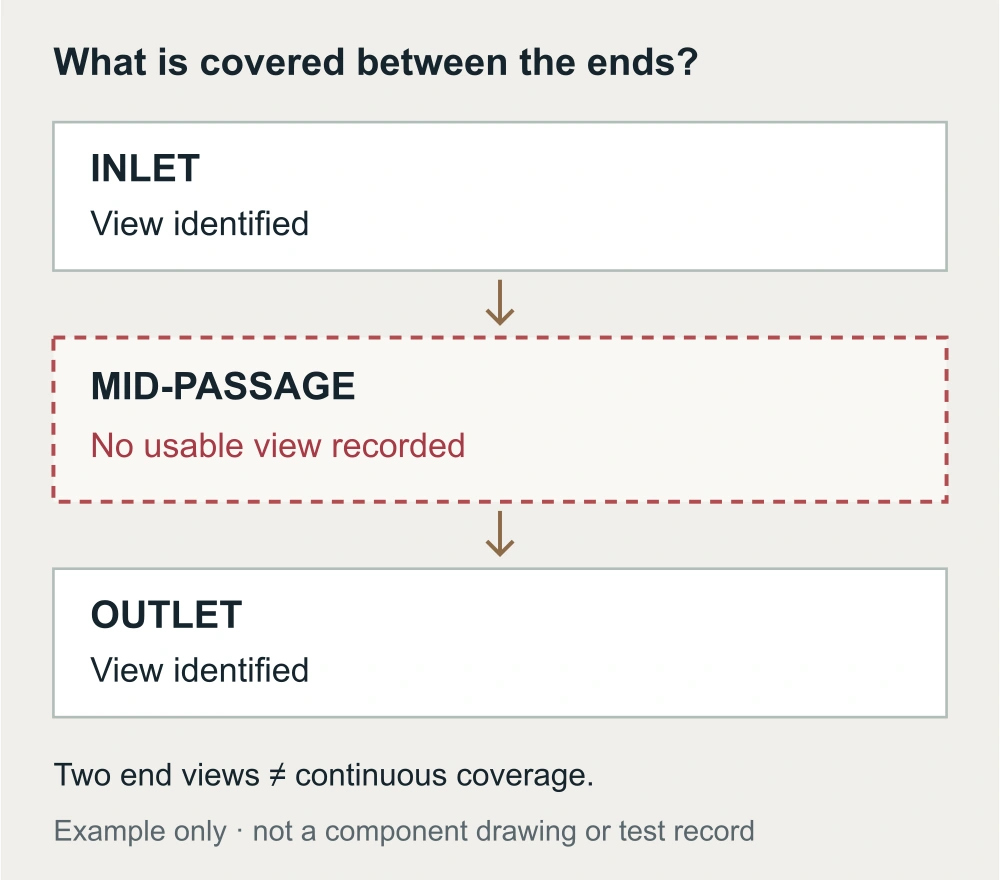
Illustrative coverage map, not a casting drawing or an actual inspection record.
Use an identifiable starting feature and a passage reference that makes sense for the actual design. Keep orientation with each view. A simple coverage record can distinguish:
Swipe the table to read all columns.
| Region | What the record should make clear |
|---|---|
| Inlet transition | Which passage entrance is shown and where the view begins |
| Mid-passage | Which internal surfaces were reached, and which remained obscured |
| Outlet | Which rim opening belongs to that passage and how it connects to the preceding views |
| Any reported finding | Location, scale or dimensional basis where applicable, and the relevant requirement |
This is an example of organizing evidence, not a mandatory inspection standard or a completed Zhiren report. The actual drawing and agreed examination scope control the work. Repeated photographs of an easy-to-see opening do not compensate for an unexamined area elsewhere.
Keep inspection findings connected to the supplied casting
“Passage checked” should mean something specific enough to review. It should not be used as a substitute for the required geometry, an unexplained surface acceptance level or a pump performance result.
Where a finding needs disposition, preserve its location before an operation changes the surface or shape. Then record the final condition against the applicable requirement. Our first-article guide explains the same requirement-to-result connection for the broader component record.
For a custom closed bronze impeller, begin the supply discussion on Zhiren's pump impeller casting page with the passage section or controlled model view and the required supplied internal condition. Those inputs describe the waterway the casting must provide, alongside its external assembly interfaces.