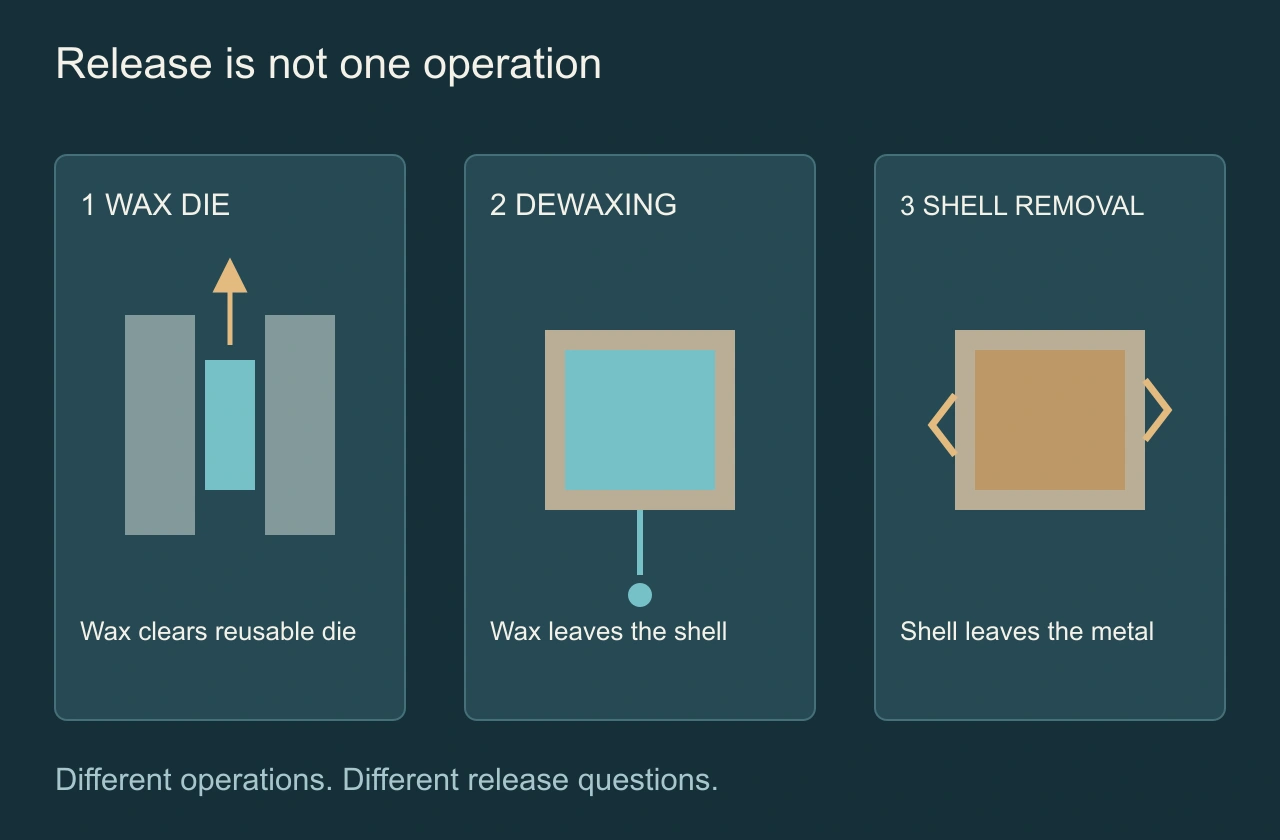
“The ceramic shell is broken away, so why does the tooling review mention draft?” For an investment-cast impeller, that question mixes two different stages. A disposable shell releases the metal casting. A conventional injection die must first release the wax pattern used to make that shell.
An investment casting draft angle discussion becomes useful once everyone identifies which surface must clear which tool, in which direction. “Lost wax” describes the process; it does not describe the complete wax-tool arrangement for a particular impeller.
Follow the part before the shell exists
In the injected-pattern route, wax fills the die and forms the pattern. That pattern must be removed, handled and assembled before the ceramic shell is built around it. Wax is subsequently removed from the shell. After pouring and solidification, the shell is removed from the metal part.
Impro's explanation of investment-casting draft separates these operations and discusses how wax behavior and tooling geometry affect release. Its point is not that every wax surface needs a prescribed taper. The practical distinction is that destroying a later shell does not answer an earlier die-release question.
A tooling comment should therefore name the operation. “Cannot release the wax at this feature” is a different statement from “cannot remove the ceramic shell.” Resolving one does not establish the other.
An undercut needs a direction
Imagine a wax cross-section with a shoulder behind a narrower opening. Moving it straight through that opening brings the shoulder into the die. That is a geometric obstruction in the stated pull direction. Turning the drawing on screen does not remove it; changing the actual parting and tool movement changes the release problem.
For an impeller, a hub recess, return profile or passage-related feature needs to be examined against the proposed tooling arrangement. A complicated-looking component is not automatically unreleasable. Equally, a smooth-looking component is not proof that a single straight pull will work.
Ask for the disputed feature on a section view, with the proposed pull direction and parting arrangement shown. This turns a broad statement about “investment casting undercuts” into a specific geometry review.
Keep a tooling proposal from becoming a silent design change
Adding taper changes a surface. If that surface belongs to a vane, passage or mating feature, easier release alone does not establish that the changed geometry meets the component requirement.
Compare the proposed wax geometry with the controlled part definition. Identify whether the change belongs to an agreed manufacturing allowance, a tool construction detail or the finished component itself. The impeller machining-stock guide explains why extra metal for a later operation must stay distinguishable from finished geometry.
There is no useful universal draft value to insert here. The feature, direction, pattern-making route and tooling arrangement have to be considered together. Record a proposed local change where it actually occurs, rather than applying an unexplained taper across the impeller.
Look at the released pattern, not only the tool drawing
A pattern that comes out is not necessarily a pattern that retains the intended shape. The Investment Casting Institute's wax-pattern defect atlas, under Distortion and Cracking, treats ejection and handling among several relevant factors. Those entries support examining the released wax; they do not diagnose a particular defect from appearance alone.
Review the condition of the feature that raised the release concern. Keep any observed distortion or cracking separate from an assumed cause. Transferring an existing die raises additional questions covered in the tooling-transfer guide; ownership of a tool is not the same issue as whether its pattern releases as intended.
For a new project through Zhiren's pump impeller casting page, mark the questioned feature, proposed pull direction and any surface that must retain its released geometry. Those details give the tooling discussion a defined component to work from.