
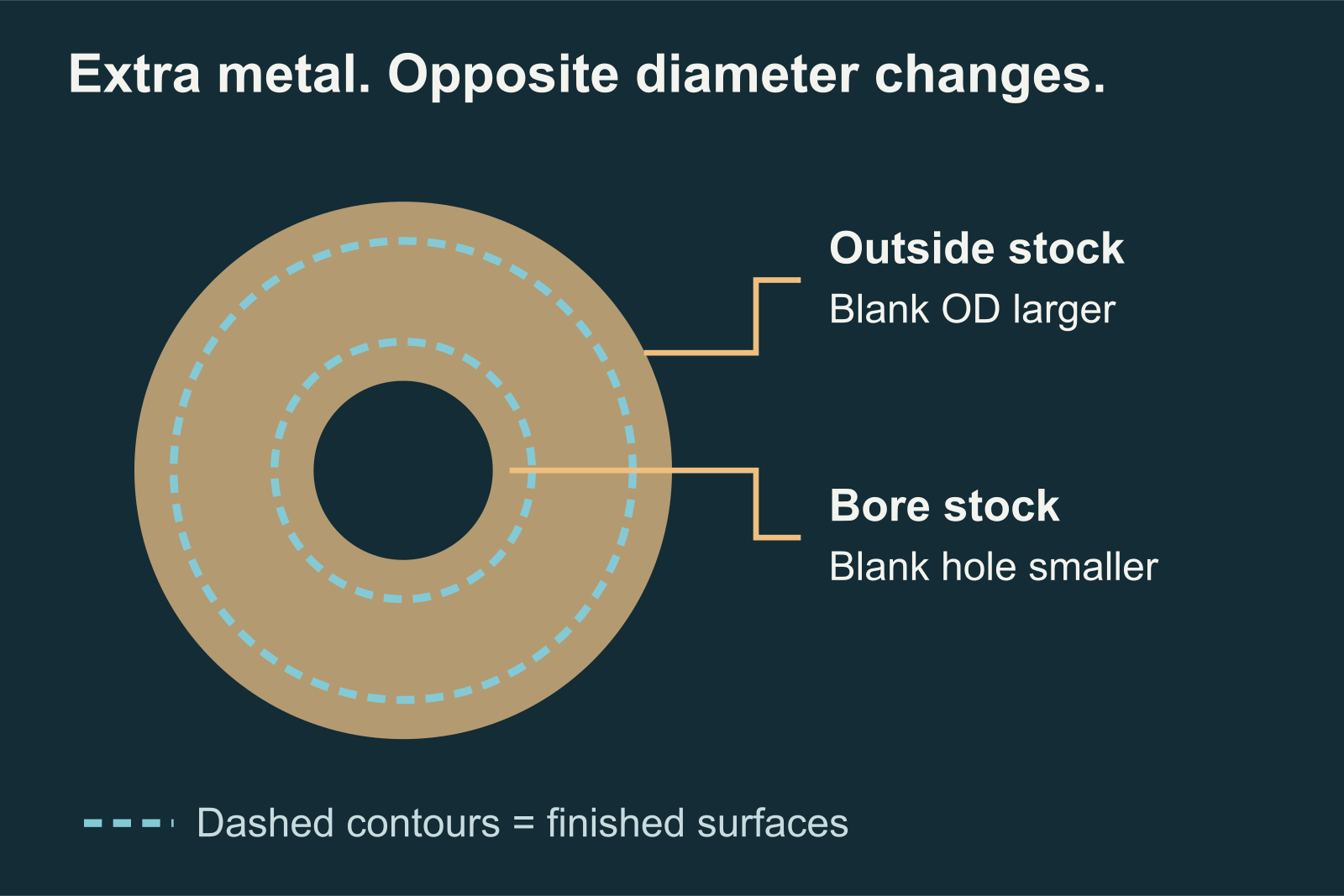
An impeller blank needs metal that the next operation can remove. On an outside diameter, that means starting larger than the finished surface. At a bore, it means starting with a smaller opening.
Both are casting machining allowance. The metal is extra in each case, even though one dimension increases and the other decreases. Enlarging every dimension of a finished model does not produce a sensible machining-stock plan.
Follow the surface that the cutter will create
For an outside running diameter, turning moves the surface inward. For a bore, boring moves the surface outward into the surrounding metal. A locating face needs material on the side from which the final plane will be cut.
This is a surface-by-surface decision. A curved vane that remains as-cast does not acquire a machining allowance simply because the nearby hub face will be turned. The casting and machining surface guide maps those different feature jobs.
On a small screen, scroll the table sideways.
| Feature to be finished | Blank relative to the finished feature | What machining removes |
|---|---|---|
| Outside diameter | Larger outside diameter | Metal outside the finished cylinder |
| Cast hole to become a finished bore | Smaller opening | Metal inside the finished bore boundary |
| Face to be machined | Metal beyond the finished plane | Stock on the specified side of that plane |
Take a simple bore example. A centered cast hole measuring 38 mm, intended to become a 40 mm finished bore, has 1 mm of radial stock: half the 2 mm difference in diameters. These are illustrative dimensions, not a recommended allowance or a Zhiren production limit.
The distinction between diameter difference and stock per side matters before comparing a supplier's blank drawing with a machining plan. Two people can appear to agree on “2 mm allowance” while referring to different quantities.
Stock has to be in the right place
The centered-hole example contains an important condition. If the cast hole is displaced from the intended machining axis, the stock is uneven around the final bore. One side has less material to remove than the opposite side.
An average diameter therefore cannot establish that every local region will clean up. Compare the blank's actual geometry with the final surfaces in the planned locating arrangement. The impeller runout guide explains why the selected axis changes the relationship being checked.
This is also why adding more metal everywhere is an incomplete answer. It does not define where the finished part sits inside the blank. The relevant question is whether the retained metal covers the specified surfaces through the intended machining route.
Shrinkage compensation happens at a different boundary
Pattern compensation addresses dimensional changes before obtaining the intended metal casting. Machining allowance is metal intentionally retained in that casting for later removal. A pattern can include both, but they serve different purposes.
The Stratasys investment-casting application guide treats shrink factors and machine stock separately. Its printed-pattern discussion is useful for that distinction; it does not provide a stock value to apply to every bronze impeller.
Casting tolerance is a third concept: the permitted dimensional variation of a feature. A tolerance is neither the deliberate extra metal nor the compensation used to arrive at the target casting. Keep the three labels attached to their own requirements.
Keep the finished definition intact
The finished drawing remains the definition of the part being purchased. The blank drawing or agreed stock model describes how sufficient metal will be supplied to reach it. The ICI's purchasing guidance distinguishes casting and machined drawings and highlights machining locating areas.
For a casting-only order through Zhiren's pump impeller casting page, mark the surfaces your shop will machine and the features it will use for locating. That lets the enquiry address the required blank without changing the final impeller geometry to hide an undefined allowance.