
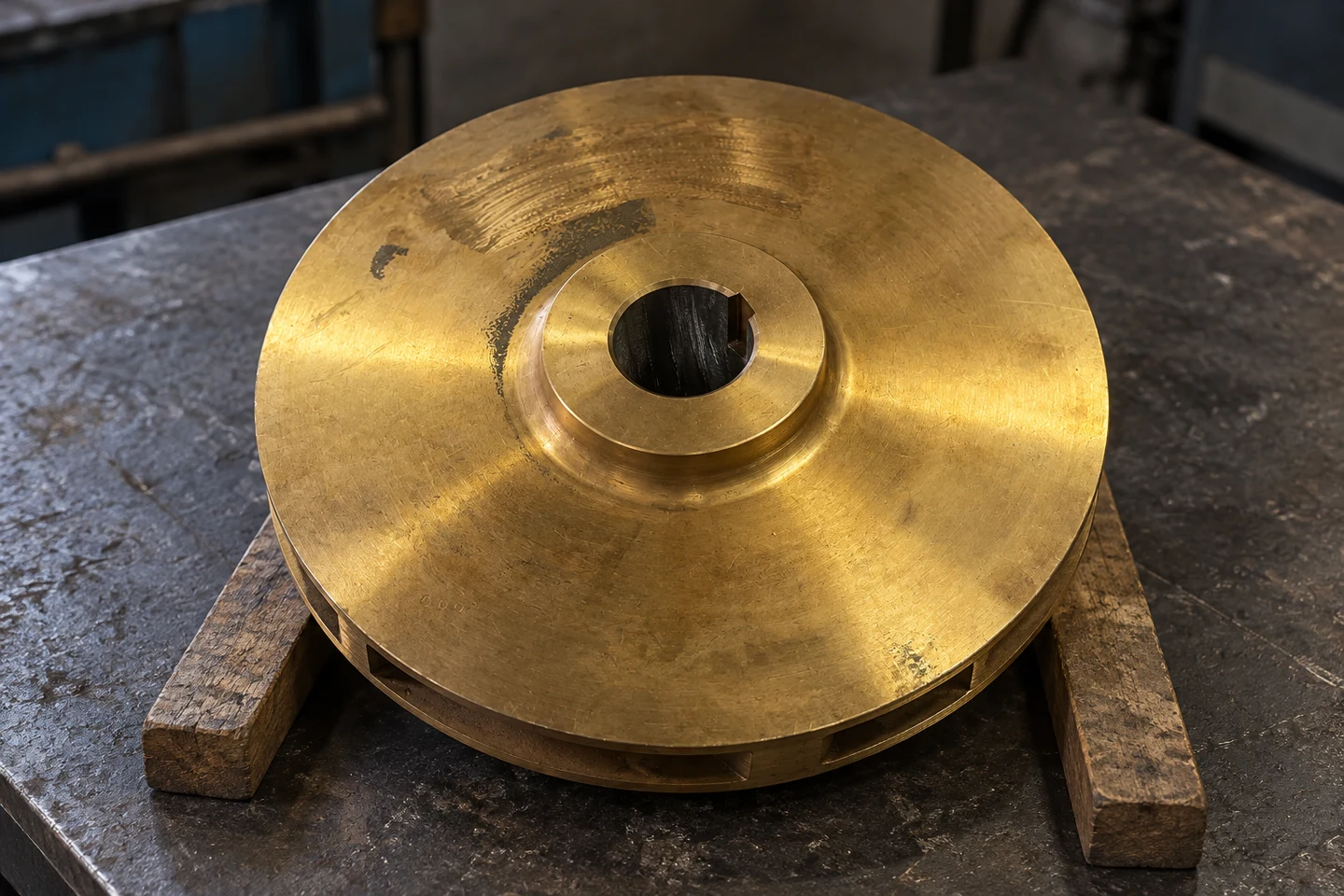
An impeller can match the old part's outside diameter and still have the wrong connection at its center. A keyed bore and a screw-on hub need different shaft ends. Neither becomes a substitute for the other because the vanes look similar.
For a custom bronze replacement, begin with the interface that transmits rotation and locates the part on the shaft. A pump impeller keyway is one feature within that interface, not a complete definition of it.
Two connections that look alike from a distance
In a keyed arrangement, a key engages the shaft and the hub so that they turn together. The surrounding bore and its mating shaft surface establish the specified fit. An end screw, nut, sleeve or another defined feature may provide axial retention; identify the arrangement on the actual drawing.
Pentair's C Series bronze-pump specification gives a concrete example: it specifies a shaft key and a separate locking screw into the shaft end. The key and the screw have distinct places in the assembly.
A threaded impeller hub has an internal thread that engages the threaded shaft end. In an archived Goulds manufacturer bulletin, the Model 3196 impeller is described as threaded onto its shaft. That 1984 bulletin is an example of screw-on construction, not a current replacement-part specification.
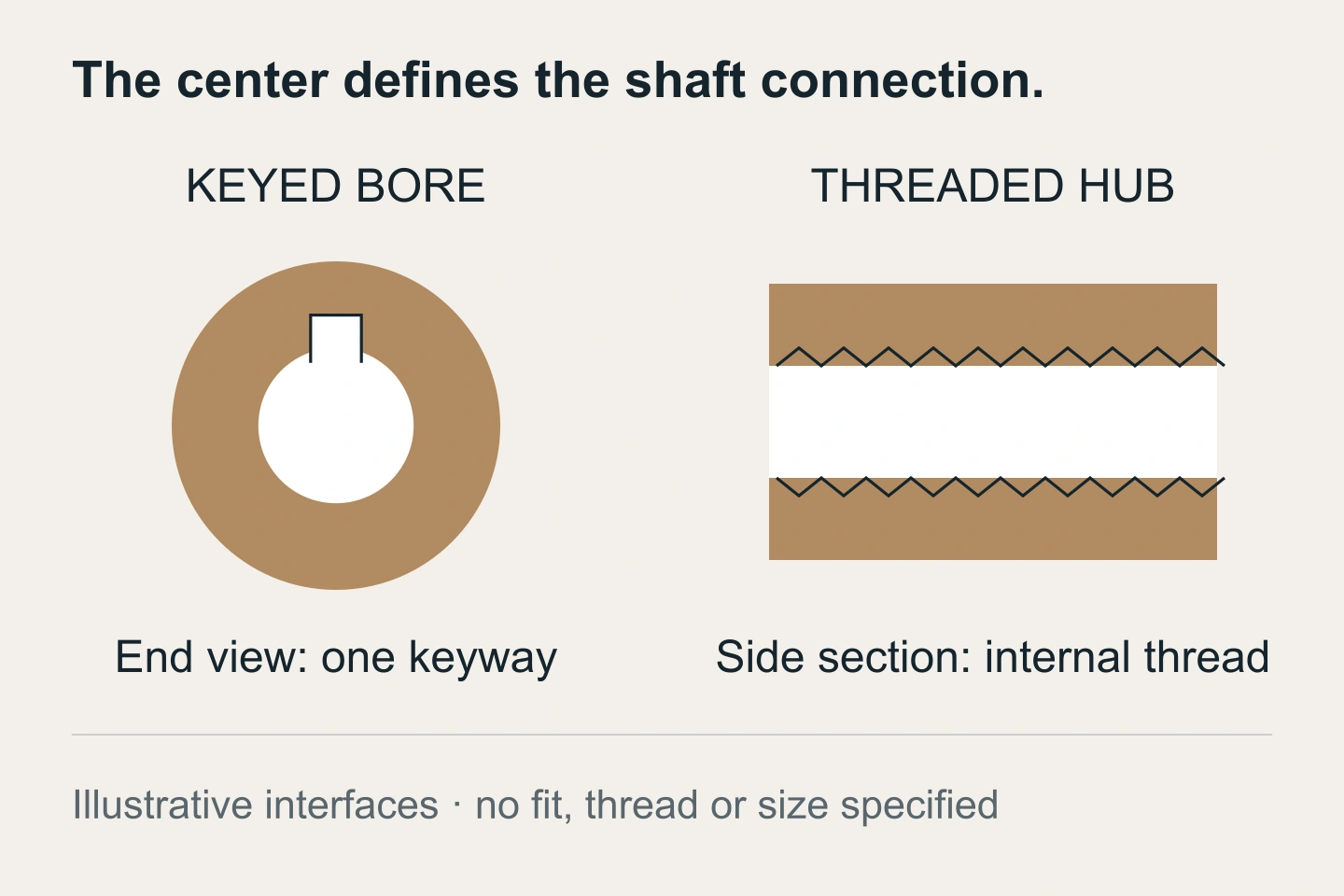
Original interface schematic. The keyed example is a straight bore; actual designs also include tapered bores.
The distinction changes the part to be manufactured. Machining a smooth bore and adding a keyway does not reproduce an internal thread. Cutting a thread does not reproduce a keyed fit or its axial seating arrangement.
First check which end of the shaft you are looking at
A key shown somewhere on a shaft drawing does not establish that the impeller is keyed. It may belong to the coupling at the other end.
The Vertiflo 629/636 parts list names a shaft coupling key and an impeller key separately. That is a useful habit when comparing an exploded view with a component drawing: follow the feature to the part it actually engages.
Use a section through the hub, or a view that clearly identifies the impeller end. A photograph of the coupling connection cannot fill in a missing hub detail. Likewise, a tool called a shaft-key wrench in a service document does not by itself describe the impeller connection.
“Keyed” still leaves important geometry to identify
The keyway is a slot, while the bore is the surrounding mating surface. Their dimensions answer different questions. A correct bore diameter does not establish keyway width or depth, and the correct keyway width does not establish the bore fit.
There is also a shape question. Vertiflo's 629/636 instructions distinguish a tapered impeller bore from a straight one. A photograph taken directly into a short bore can hide that difference. Do not replace a taper with a straight bore because the opening measures the same at one end.
For a keyed component, the useful detail connects:
- the bore's defined shape and fit to the mating shaft;
- the keyway's width, depth, length and location;
- the shoulder, face or other feature that sets the impeller's axial position;
- the specified retention arrangement.
These features belong together, but they should keep their separate dimensions. A nominal shaft diameter is not permission to infer a standard keyway or an unmarked fit.
A threaded hub needs more than “right-hand”
Thread hand identifies one aspect of the thread. It does not supply the diameter, pitch, thread form, fit requirement or engagement and seating geometry.
Keep those details with the mating shaft definition. Also distinguish a thread-hand note from a rotation arrow: “right-hand thread” and “clockwise viewed from the drive end” describe different things. Our impeller rotation guide explains why the viewing end must travel with a CW or CCW note.
This is a component-definition check, not a reason to change the pump's drive arrangement. The required hub connection follows the released assembly design.
Put the hub detail into the manufacturing order
Separate a casting blank from a finished hub. A blank supplied for later machining and an impeller supplied with finished mating features are different delivery states, even when their cast external geometry is the same. The impeller casting and machining guide explains that boundary.
For Zhiren's custom pump impeller castings, send the hub-to-shaft section and the required delivery state. Those two inputs establish which connection the component must provide and which features belong in the supplied part.