
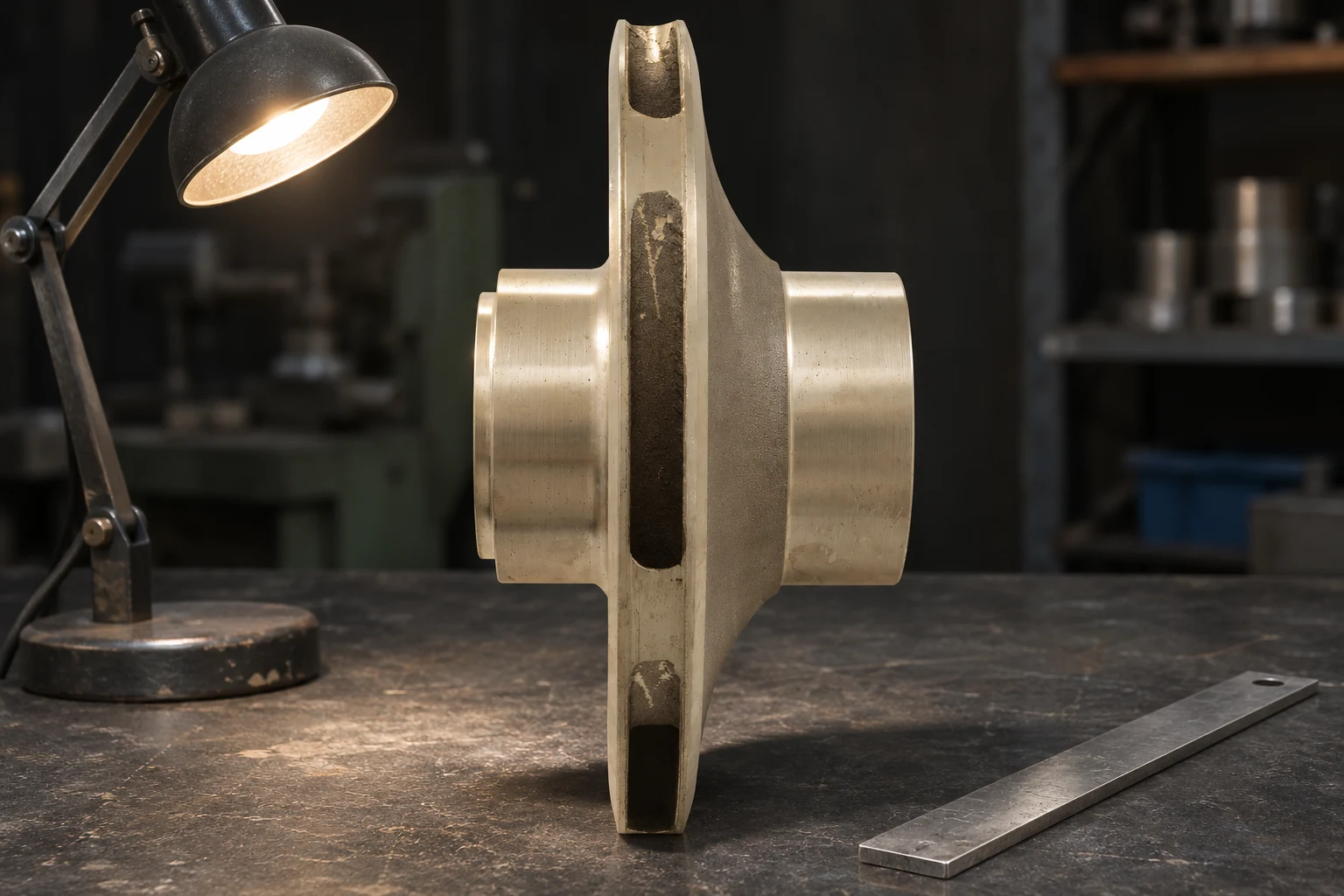
A bright patch where a gate used to be is easy to spot. The harder question is whether finishing stopped at the impeller surface or continued into it.
Investment casting gate removal has two boundaries to respect: the connection that must disappear and the component geometry that must remain. “Blend smooth” describes a transition. It does not define how much metal can be removed.
The cutoff and the cleanup leave different evidence
The cutoff operation separates the casting from its feed connection. Local finishing then takes down the remaining gate contact. These steps can leave different marks. The Investment Casting Institute describes cut-off damage as a cutting tool entering the component, and grinding damage as abrasive removal continuing past the gate into the casting.
That distinction changes what a reviewer should look for. A slot beside the contact and a broad ground depression are different observations. Calling both “gate marks” hides the shape that needs investigation. Neither observation identifies its cause from a photograph alone.
Three profiles that can look equally clean
Imagine a section through the gate contact. Draw the required component boundary first, then compare the cleaned surface with it.
On a small screen, scroll the table sideways.
| Local profile | What is present | What the appearance cannot settle |
|---|---|---|
| Above the required boundary | A remaining projection | Whether the permitted gate remnant allows it |
| At the required boundary | The intended local contour | Whether separate texture or discontinuity requirements are met |
| Below the required boundary | Material removed from the component | Whether the remaining geometry is acceptable |
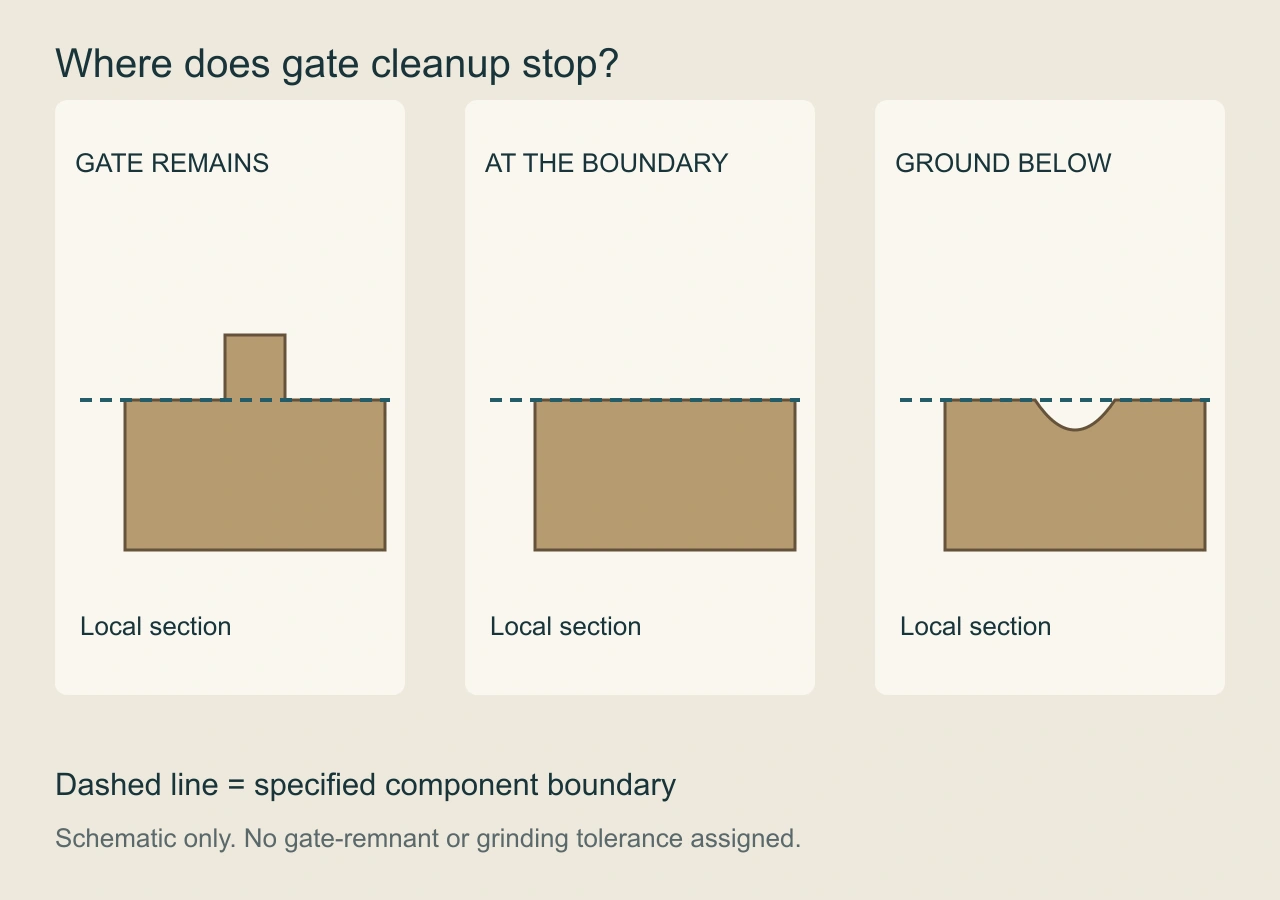
A low area does not become extra machining stock because it is smooth. Stock is metal deliberately left for a later operation. A depression is metal already removed. The impeller machining-stock guide explains that surface-by-surface distinction.
The same cleanup instruction changes meaning across the impeller
At a hub face scheduled for machining, compare the cleaned blank with the stock needed to produce the finished face. At a shroud or passage surface that remains as-cast, there is no assumed later cut that will recreate missing metal. Review the local contour itself.
Near a vane root, a broad blend can also change the defined transition between surfaces. A gate-cleanup instruction should not silently replace the controlled root fillet.
Keep surface texture and geometry as separate questions. A roughness reading describes texture over its measurement path; it does not, by itself, locate the whole surface relative to the component boundary. An attractive ground patch is therefore only part of the acceptance evidence.
For a custom bronze impeller, identify any restricted gate-contact areas and the local surfaces that must remain as-cast. Start with the pump impeller casting product page and carry those marked features into the enquiry. That gives the finishing discussion a physical boundary instead of an open-ended request to make the patch look better.