
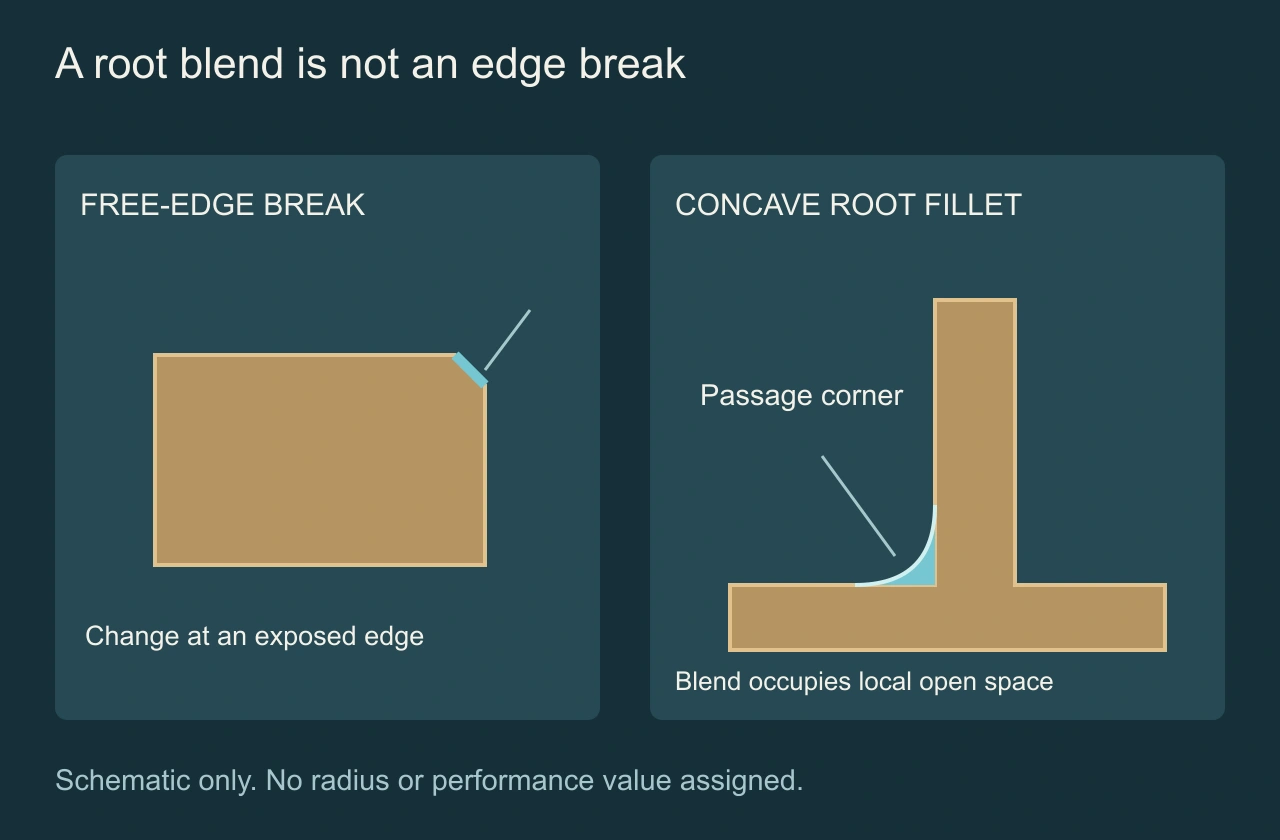
“Round off the sharp edges” does not define the transition where an impeller vane meets a hub or shroud. A small break on a free edge removes the sharp corner at that edge. A concave fillet at the vane root blends two meeting surfaces and occupies space in the corner between them.
For a bronze impeller casting, that distinction matters before anyone changes the model or dresses the casting. The impeller fillet radius belongs to a particular region of the component, not to a general instruction to make everything look smoother.
Locate the root on a section
Take a section through the vane-to-shroud junction. Identify the vane surface on one side and the shroud surface beside it. The root blend joins those parent surfaces. Increase that blend while holding the parent surfaces in place, and more metal occupies the previously open corner.
The local metal section changes. So does the boundary of the passage at that location. That geometric consequence does not, by itself, quantify flow loss, cavitation resistance or stress. It does explain why “use the largest possible radius” is an incomplete design instruction.
The same word can also hide different locations. A vane-to-hub blend is not automatically the same feature as a vane-to-shroud blend. Identify which junction is under discussion and how far the requirement extends along it.
Casting advice needs a component boundary
The Investment Casting Institute's crack atlas lists sharp internal angles and adequate fillet radii among its geometry-related considerations. That is a reason to examine an abrupt transition. It is not a radius specification for every bronze impeller, or proof that an observed crack came from that transition.
The Steel Founders' Society of America's casting-design framework explains the competing demands of component function and casting manufacture. That general design principle is useful here; numerical recommendations for another alloy or casting route are not automatically transferable.
A proposed root change therefore needs two comparisons: what it does to the local casting section, and what it does to the released component geometry. A foundry recommendation is an input to that review, rather than permission to change a controlled passage without agreement.
Define the blend instead of relying on its appearance
A radius note needs a location. Show the adjacent surfaces, the region covered and any local exception at the ends or intersections. If the blend varies along a curved root, the controlled surface definition must make that variation understandable. One isolated radius value cannot describe an unspecified changing surface.
An attractive photograph cannot settle this definition. Neither can a vane-thickness result taken away from the root. The vane-thickness inspection guide deals with locating a thickness measurement; this review identifies the transition itself.
Keep a designed blend distinguishable from unwanted flash or a surface discontinuity. A general cleanup instruction should not silently remove metal that belongs to the defined root. Conversely, a lump at a junction is not an acceptable fillet merely because it makes the corner look rounded.
Compare the same feature before and after a change
Use the same section and parent surfaces when reviewing a proposed revision. Otherwise, a larger-looking blend in one view and a smaller-looking blend in another can reflect different section locations rather than a real design difference.
For a new enquiry through Zhiren's pump impeller casting page, identify the controlled vane-root region and the adjacent passage surfaces that must be retained. That provides a usable starting point for discussing the transition without substituting a generic casting radius for the impeller's own geometry.