
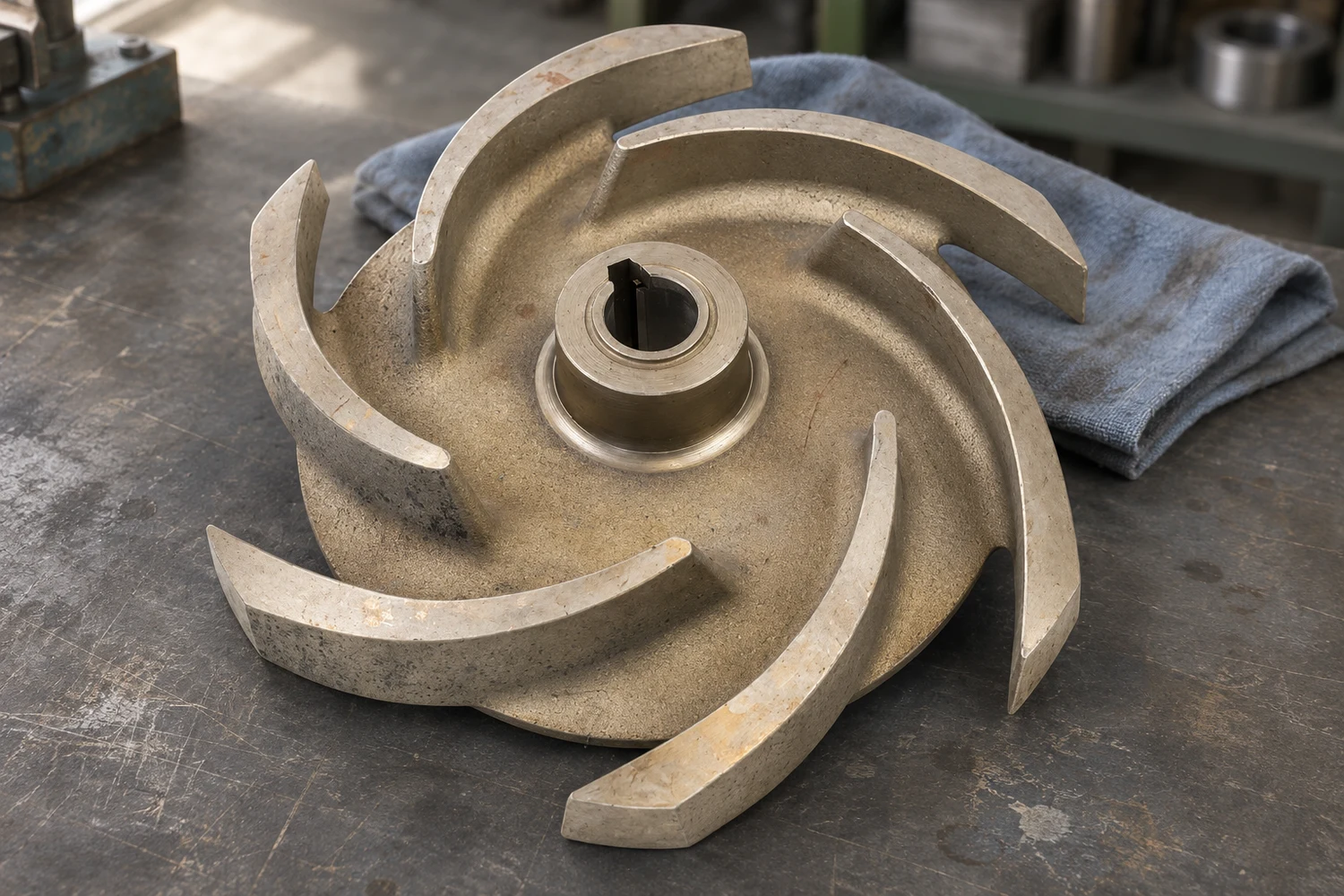
“The vane measures thinner than specified” is a conclusion worth checking against the section view. Was the measurement taken at the inlet, at the outlet, or farther along the curved vane? Were the requirement and the result taken at the same defined location?
An impeller vane thickness value belongs to a particular part of the profile. A measurement from an accessible edge does not automatically represent the rest of the vane.
Follow the profile instead of looking for one wall value
KSB describes a flow profile through its median line and thickness distribution. That is a useful starting distinction: the profile has a defined shape, and its thickness need not remain constant along that shape.
On a component drawing, follow the identified section and dimension direction. A distance taken along an arbitrary line across a curved vane can describe a different span from the one specified. The answer is to locate the intended section, not to select whichever accessible measurement produces the preferred number.
This also explains why an edge photograph is limited evidence. Perspective changes the apparent span, and a shroud can conceal part of the profile. The photograph can identify the vane and checking area; it does not establish a dimensional result.
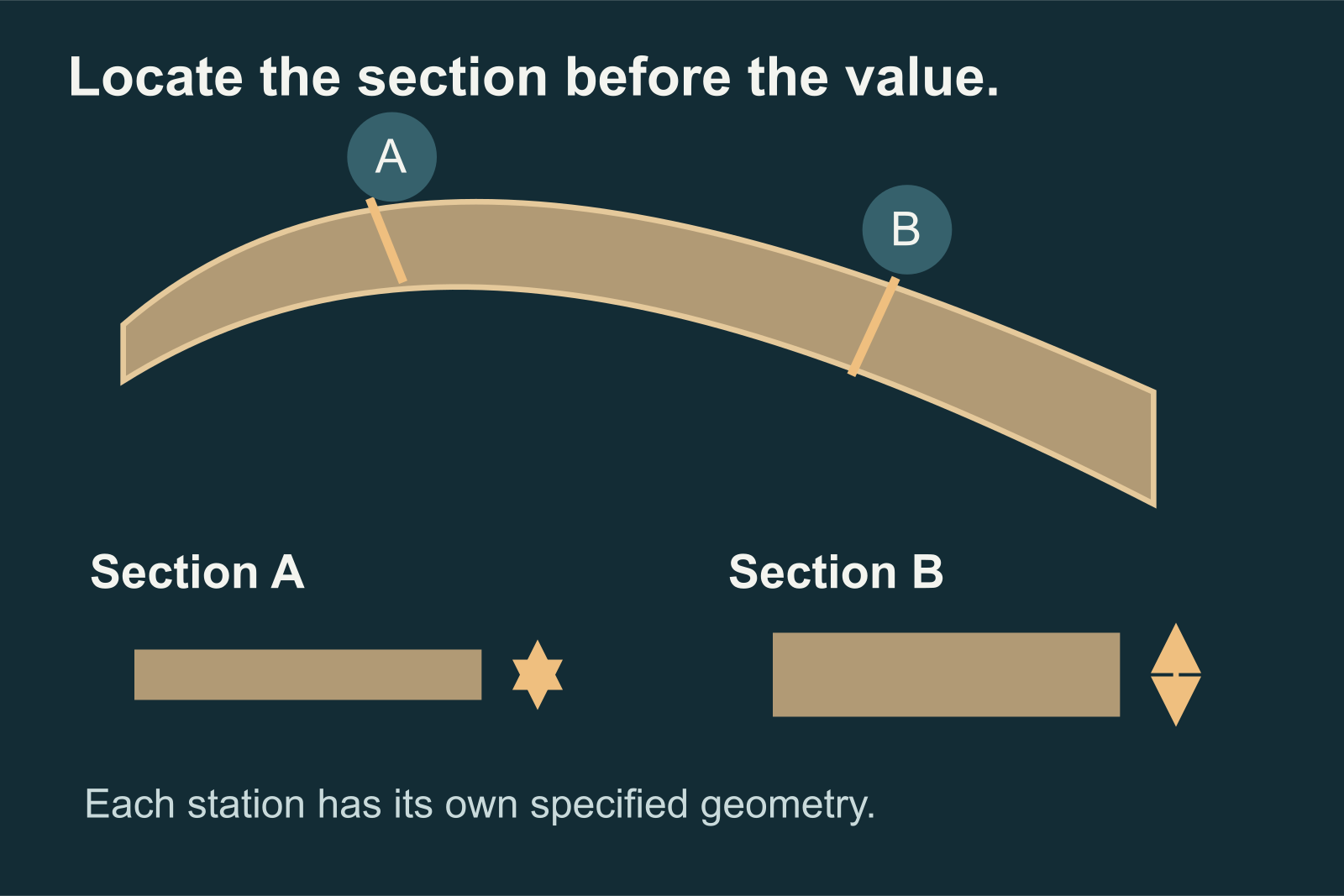
Original section concept. The two stations are illustrative, not a pump design or dimensional acceptance example.
Thickness, spacing and passage width answer different questions
The metal and the open passage should keep separate dimensions.
On a small screen, scroll the table sideways.
| Check | What is being assessed | What it does not establish |
|---|---|---|
| Local vane thickness | Metal between the vane surfaces at the defined section | The thickness everywhere else along the vane |
| Vane spacing | The arrangement of neighboring vanes at the stated location | The local thickness of either vane |
| Passage width or outlet width | The specified open flow-path dimension | The complete profile or all other passage dimensions |
Sulzer's published PS3107 purchase specification treats these as separate checks. It identifies inlet/outlet thickness, vane spacing and passage dimensions, then addresses agreement on hydraulic-profile measurements. The useful lesson is the separation of features. Its Class A/B requirements and numerical limits should not be copied into an unrelated bronze order.
If extra metal projects into a passage, the local opening changes. That observation alone does not calculate the finished pump's flow, head or efficiency. The component must first be compared with its specified geometry, rather than accepting or rejecting it from a performance assumption.
For a closed impeller, the internal-passage guide covers the separate question of what inspection access actually reaches. Seeing an inlet edge is not the same as covering the passage behind the shroud.
Surface dressing must preserve the defined vane
A casting witness that needs removal and a deliberately shaped vane edge are different features. The finishing instruction must distinguish them. A request to clean or smooth the casting does not by itself authorize changing the profile, thinning every edge or enlarging the flow passages.
Keep the acceptance comparison tied to the specified final condition. A dimension before an agreed finishing operation and a dimension afterward describe different surfaces. Record which condition the result represents without treating material removal as a universal solution to a thickness disagreement.
For replacement work, service wear adds another boundary. An eroded edge may no longer retain the original thickness or contour. The seawater impeller wear guide explains why lost geometry should not simply be copied into the next casting.
When enquiring through Zhiren's pump impeller casting page, provide the vane section or profile with the thickness-check locations marked. Those references let the manufacturing discussion address the metal shape being ordered, rather than an undefined request for thicker or thinner blades.