
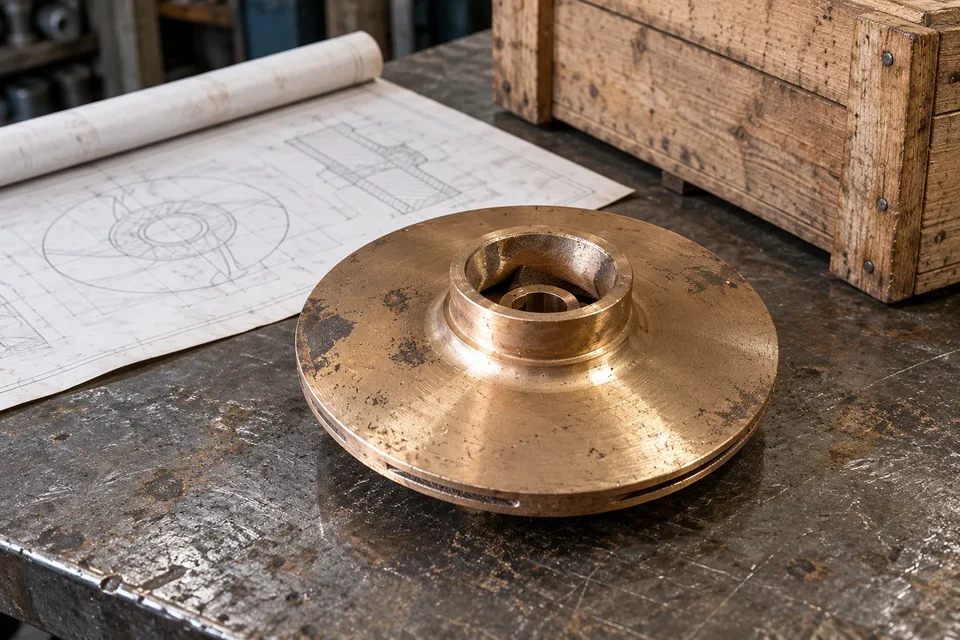
“Make it like the last order” is a poor starting point when the last order came from a different foundry. The buyer may have a successful impeller in hand without a clear record of who cast it, who finished it, or which version of the drawing each company used.
When changing a bronze impeller casting supplier, separate the definition of the part from the way the old source made it. Carry forward the approved requirements. Identify which manufacturing assumptions need fresh evidence.
This matters whether you are replacing a source or adding a second one. An impeller that looks familiar can arrive at a different delivery state, with a different machining responsibility, even when the purchase order uses the same part number.
First decide what is actually moving
There are three different projects hidden inside “supplier transfer.”
Swipe the table to read all columns.
| Project | What stays fixed | What the buyer needs to resolve |
|---|---|---|
| Same part, new foundry | Approved part definition and required delivery state | How the new source will make and demonstrate the specified part |
| Same part, different supply scope | Finished-part requirements | Who now supplies the casting blank, performs machining and delivers the accepted component |
| Revised impeller | Only the requirements retained in the new revision | Which changes belong to the design, and what evidence must address them |
Do not combine these into one vague sample request. A new source can manufacture the same design; it can also be asked to take over more operations. Those are separate changes.
For example, suppose the old foundry delivered a blank to your machine shop. The new quotation offers a finished bore and hub faces. The part number has not changed, but the supplier's responsibility has. Comparing the two offers as if both ended at the casting stage would miss that difference.
If the boundary is unclear, use the feature map in which impeller surfaces need machining to define where the casting supply stops.
Rebuild the baseline from controlled information
Start with the current drawing revision, its referenced specifications and the agreed delivery state. Keep the old sample beside them as a reference, rather than allowing it to become an undocumented drawing.
An old sample can show the form of a passage or the appearance of a machined surface. It cannot tell you which of its dimensions were intentional, which were at one end of a tolerance, or which later changes were approved. A worn service part adds another ambiguity: the shape you can measure now is not necessarily the original shape.
Make a short baseline sheet with three headings:
- Required: the current design and acceptance requirements.
- Historical: old samples, previous reports and explanations of past practice.
- Proposed: changes offered by the new source that still need a decision.
This separation prevents a proposed change from slipping into the order simply because it appeared in a quotation email. Pentair's Supplier Guide, section 4.6, explicitly requires clarification of drawing/specification gaps before quotation or manufacture and does not let informal agreements supersede those documents. That is Pentair's purchasing rule; the practical lesson is to settle the definition before making the sample.
Treat transferred tooling as an asset, not an approval
A crate arriving at the new foundry establishes that an asset moved. It does not establish which drawing revision the tool represents, what condition it is in, or whether the recipient can use it for the proposed manufacturing route.
Prepare an asset record that identifies the tool or file, the part/revision it relates to, its documented condition and the authorization to release it. Include associated inserts or other necessary items where they exist. A tool number without its part relationship leaves the new source reconstructing the history.
Keep two milestones separate: tooling received and tooling accepted for the proposed use. Do not put a production release date against the first milestone.
The same principle applies when no old tooling moves. A CAD model is a useful input, but its file date does not establish that it is the approved production definition. Tie it to the drawing/revision used for the transfer.
Ask whether the sample represents the next order
Before making samples, describe the intended route in plain language: where the casting is made, which operations are included, where finishing occurs and what delivery state reaches your receiving department.
Then compare the sample route with that route. If a sample is finished by your own machine shop but the production order will be finished elsewhere, the sample has not answered every question about the proposed finished supply. Record the difference instead of letting “sample approved” cover it.
Weir's Supplier Quality Manual, section 3.5, lists first manufacture, relevant manufacturing changes and tooling/location changes among its first-article triggers. This is a named buyer's procedure, not a universal requirement for every order. It shows why approval history belongs with a defined source and route.
For the detailed review of the resulting records, use how to read an impeller first article report.
Release the differences you have resolved
A useful transfer sheet does not repeat every drawing note. It makes changes visible and records how each one is closed.
Swipe the table to read all columns.
| Transfer item | Proposed condition | Evidence or decision before release |
|---|---|---|
| Part definition | Current revision retained | Buyer and supplier use the same issued definition |
| Delivery boundary | Blank becomes machined supply | The included operations and delivered features are explicit |
| Tooling | Existing asset moves | Identity, condition and proposed use are resolved |
| Sample route | Different finishing source | The difference is evaluated for the intended order |
| First delivery | New source's parts | Agreed acceptance evidence is connected to those parts |
Choose the next action from the unresolved row. A missing revision calls for the correct definition. A scope mismatch calls for a revised supply boundary. A sample/report mismatch calls for the missing evidence. Asking for another attractive sample will not resolve all three.
Sulzer's public casting supplier assessment separates process, material and casting size/weight scope. Use the same discipline when considering a foundry: match the proposed part to a stated manufacturing scope, rather than treating “bronze casting supplier” as a complete qualification.
Put the impeller scope on the table
Zhiren manufactures copper-alloy castings, with as-cast and machined supply options. For a transfer discussion, start with the current impeller drawing and identify which operations you want to move. Include the specified alloy and order quantity so the part and supply boundary can be reviewed together.
Review bronze pump impeller casting supply before preparing the transfer request.