
An impeller model opens, rotates and looks smooth. Before using it for a casting quotation, there is still a practical question: what geometry and requirements actually reached the receiving system?
The STEP vs STL for casting decision starts there. An attractive preview can confirm the general shape while leaving the nominal surface, unit interpretation or manufacturing definition unresolved.
Look beneath the shading
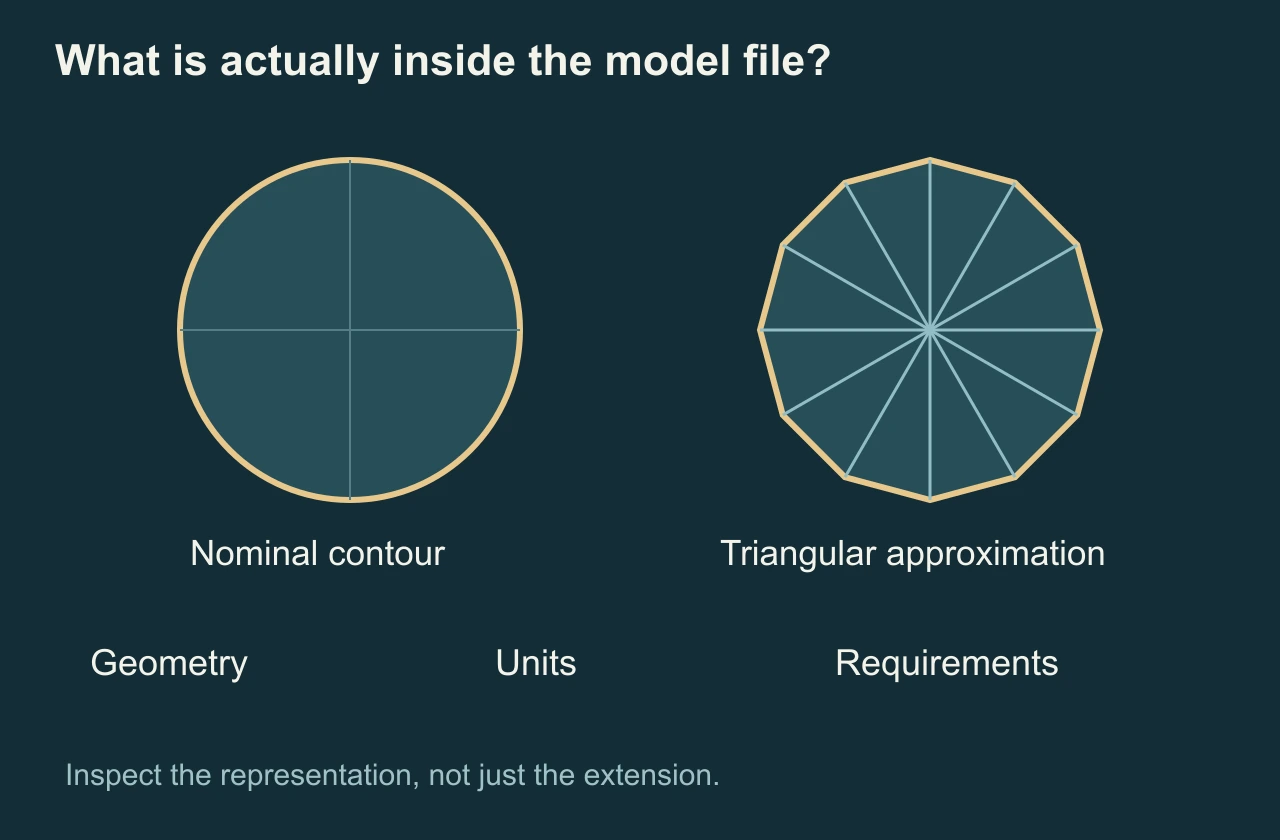
An STL represents a surface with triangles. A curved passage or hub is described through that tessellation, and the display can shade neighboring facets so that the model looks smooth. Autodesk's export documentation identifies STL as a triangulated surface format.
Increasing mesh density can make an approximation finer. Display shading can make its boundaries less obvious. Neither observation establishes that the file contains the original nominal surface definition.
This matters when an impeller's bore, vane profile and shroud are being used for different manufacturing tasks. A useful receiving check identifies the imported object: a mesh, a surface set or the intended CAD body. It then checks the features needed for that task. Merely reporting “file opened” stops before this distinction.
A STEP suffix does not describe everything inside
STEP provides a route for exchanging part and assembly information between engineering systems. It can also carry product and manufacturing information, or PMI. NIST's STEP explanation distinguishes interpretable semantic PMI from the graphic presentation of annotations.
Inspect what was exported and what the recipient can read. A model with geometry only should not be treated as if it also carried every bore tolerance, finish requirement and datum relationship from the design release. An annotation visible in a screenshot does not establish that the receiving system has interpreted the same requirement.
Likewise, saving an existing mesh in another container does not, by itself, recover missing nominal geometry or design requirements. Conversion can change the representation. It cannot supply a requirement absent from its input.
Give the unit check one known dimension
STL itself is unitless. Autodesk exposes unit choices in the export workflow, so the unit assumptions on both sides of the handoff need to be understood.
Choose one known dimension from the released definition and compare it with the imported model. If that reference is a bore diameter, identify the bore and its intended unit explicitly. A consistent-looking impeller can still have the wrong physical scale.
Resolve the scale before comparing clearances or preparing manufacturing data. A screenshot at a different zoom level cannot establish whether the coordinates were interpreted correctly.
Tell the receiver which state the model defines
An approved finished-part model and a proposed casting-stock model answer different questions. Additional metal around a hub is meaningful only when its relationship to the finished geometry is retained. See the impeller machining-stock guide for that surface-by-surface distinction.
A mesh can still have a legitimate role in visualization or an agreed workflow. The acceptance question is whether the supplied representation and specification support the intended manufacturing task. Do not silently promote a useful reference model into the complete component definition.
For a new enquiry through Zhiren's pump impeller casting page, provide the controlled model, its supporting drawing or model-based requirements, and one dimension for checking import scale. The handoff should identify the received geometry and release, rather than ending with confirmation that a picture appeared.