
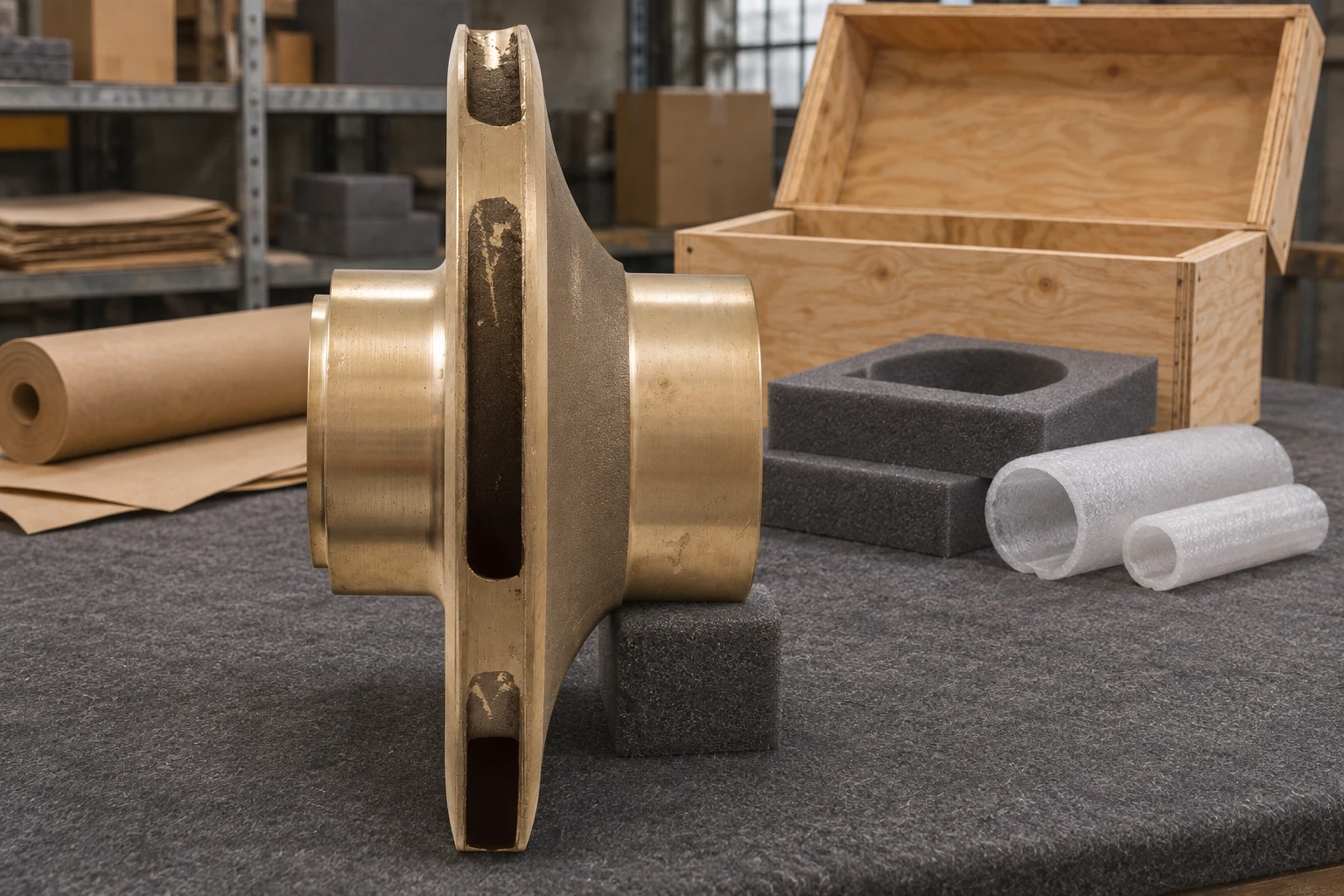
The crate arrives with its corners intact. Inside, two impellers have moved against each other, or a finished face has rubbed against a packing contact. The outer box has survived; the component condition has not necessarily survived with it.
That is an illustrative packing problem, not a reported customer incident. It shows why pump impeller packaging needs to address the part inside the case as well as the case itself.
Decide which condition is being protected
An as-cast blank and a machined impeller are different packing jobs. A blank may still carry metal intended for later removal. A finished bore, thread or seating face has already reached a specified condition and should not be treated as spare contact stock.
Identify the delivered state on the component definition. Then identify the surfaces that need protection from contact, abrasive movement or contamination. The cast-versus-machined surface guide helps separate those surface states; a rough appearance alone does not establish whether a feature is unfinished or damaged.
Thin or projecting features also need attention. Vane edges, hub projections and shroud rims do not provide interchangeable contact areas. The part geometry and actual packing design determine where support and restraint can be applied.
Give each layer a job
Think of three separate questions:
On a small screen, scroll the table sideways.
| Packing function | The question it must answer |
|---|---|
| Outer containment | Does the case provide the required enclosure and handling protection? |
| Internal restraint | What prevents the component from moving or contacting another part? |
| Surface protection | What separates the specified features from rubbing, debris or unwanted contact? |
A protective sleeve can keep debris off a feature without restraining the component. Soft material between two loose parts can separate them initially without establishing that they remain separated during transport. A strong case does not answer either question by itself.
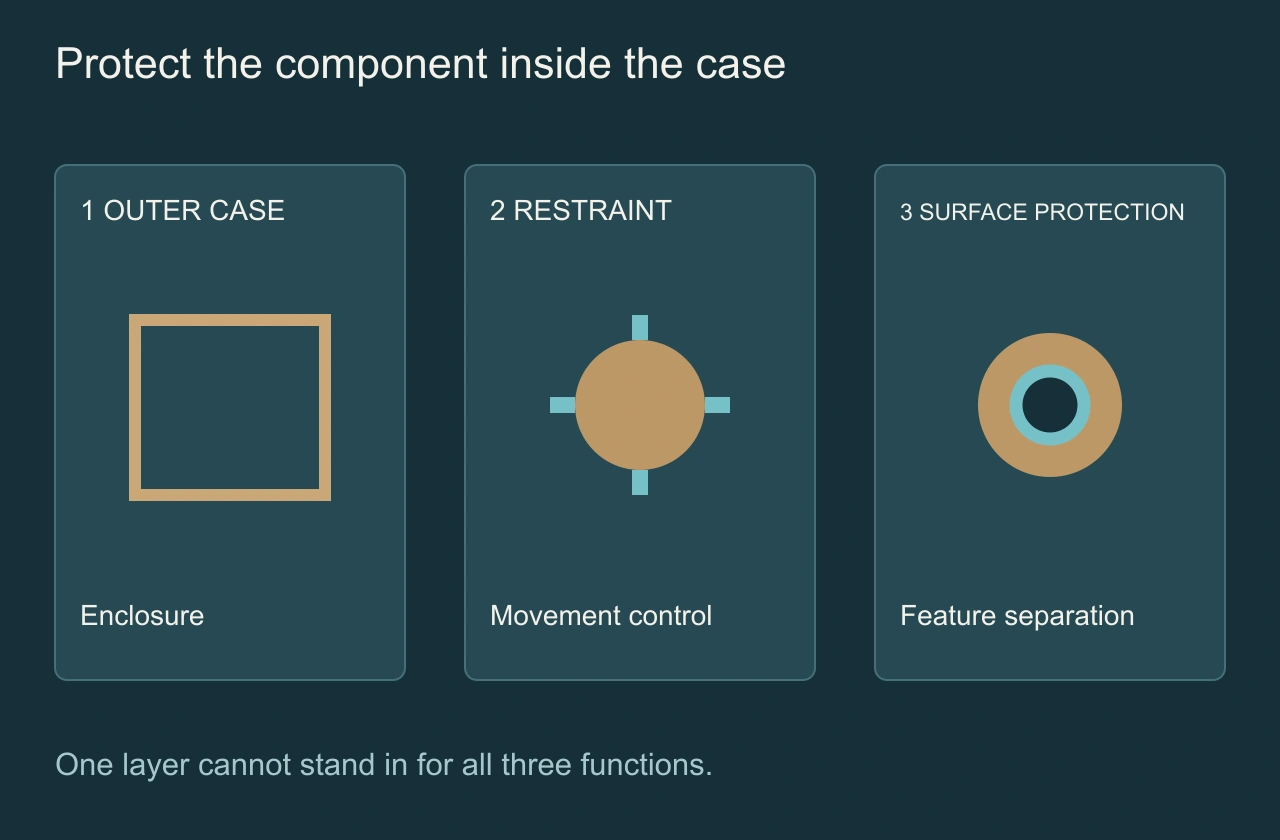
Packing functions, shown schematically. This is not a load-rated package, support drawing or material specification.
Review the contact locations in the proposed arrangement. What carries the component's weight? What prevents it from shifting? What prevents a neighboring part or packing element from bearing on a protected surface? Those questions are more useful than approving a package solely from a photograph of its closed lid.
Put buyer requirements ahead of a generic packing label
Pentair's Global Supplier Guide, section 4.4, requires suitable protection during shipment and storage and conformity to the relevant drawing, specification or purchase-order packing requirements. Its routing guidance also treats transport protection as more than satisfying minimum packaging provisions.
These are named OEM requirements, not a universal packing standard or a claim of supplier approval. For an actual order, use the applicable buyer requirement and the agreed component condition. A label such as “export packing” does not define which features are protected, what holds the part or what condition is expected on receipt.
Preserve a comparison at dispatch and receipt
Useful dispatch photographs show the identified component, its visible condition, contact locations and the arrangement before closure. At receipt, record the case and visible packing condition before dismantling the arrangement, then record the component features being checked.
Those records help compare what is visible at each stage. They do not alone establish the cause or timing of every mark, nor replace a specified dimensional or surface examination. Keep a receiving finding connected to the part identity and the acceptance requirement, rather than calling every mark transport damage.
For a custom order through Zhiren's pump impeller casting page, identify whether the delivery is as-cast or machined, and which finished or vulnerable features need protection. That lets the packing discussion follow the actual impeller condition instead of ending with the choice of a wooden box.