
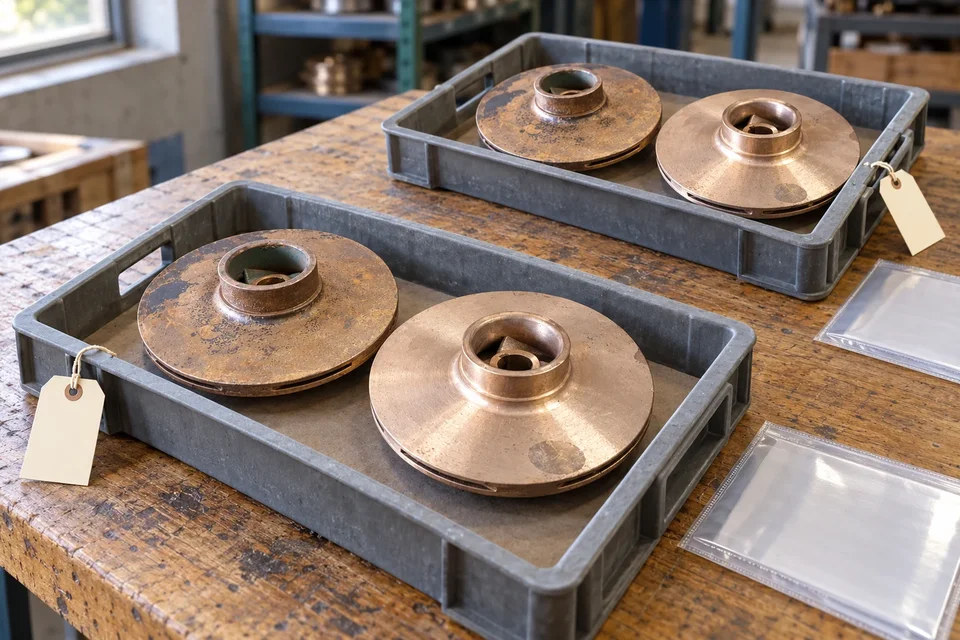
The delivery contains bronze impellers and a material certificate. Both look in order. One question remains: which of these impellers does that certificate describe?
For bronze impeller casting traceability, having the document and connecting it to the parts are separate tasks. A part number identifies a design. A purchase order identifies an order. Neither necessarily distinguishes the production groups within that order.
A useful receiving check follows the connection in both directions: from a package to its applicable material record, and from that record to the other parts it covers.
Give each identifier one job
Foundries, machine shops and buyers do not have to use identical codes. They need a recorded relationship between the codes that matter to the order.
Swipe the table to read all columns.
| Identifier | Question it helps answer |
|---|---|
| Part number and revision | Which component definition is being supplied? |
| Heat or other agreed material identity | Which material record applies? |
| Casting lot | Which group of castings is being tracked? |
| Machining job or batch | Which processing group handled these parts? |
| Shipment and package identity | Where are the identified parts being delivered? |
A heat, casting lot and machining batch are not automatically the same grouping. A heat may feed more than one recorded group; a machining job may need to preserve several incoming identities. Ask how the supplier's system maps them rather than insisting that every document repeat one convenient number.
Pentair's Global Supplier Guide, section 6.1, describes lot/batch traceability across materials, process information and shipments, with requirements developed for the project. It does not establish one marking format for every buyer or impeller.
Try a shipment that contains two lots
The following identifiers and quantities are fictional. They illustrate a record relationship, not a delivered Zhiren order or material test result.
- Heat H-EX-A → casting lot C-EX-A → machining job M-EX-1
- Heat H-EX-B → casting lot C-EX-B → machining job M-EX-2
The order is shipped in two boxes. Box BX-EX-01 holds four parts from C-EX-A. Box BX-EX-02 holds two parts from C-EX-A and three from C-EX-B.
A packing list that says only “nine bronze impellers” leaves the buyer without the lot distribution. Adding both material certificates to the shipment does not identify the mixed box's contents.
The receiving record needs to show the package-to-lot mapping. Inside the mixed box, separate identified groups or another agreed identification method must preserve that mapping when the box is opened. The paperwork cannot supply a distinction that the physical grouping has already lost.
A simpler packing plan may avoid mixing the groups in the first place. The important question is whether the identity still works after normal unpacking, not whether the outside of the carton looks well labeled.
Watch the handoff into machining
An identity stamped on a surface scheduled for machining needs a plan for maintaining the link when that surface is removed. The same issue appears when castings leave one container and enter another for processing.
Decide how the incoming lot relates to the machining job before the transfer occurs. Where one job includes more than one lot, retain the distinction through the work and its output. Writing a new job number on the container does not, on its own, preserve the incoming material identities.
Do not solve this by adding marks to a bore, locating face or hydraulic passage without an approved marking requirement. Specify the permitted method and location as part of the component's requirements.
Batch-level identification and individual serial numbers are different scopes. Choose the level required for the project and make sure the method actually maintains it.
Traceability and material acceptance answer different questions
A complete identity chain can lead to a material record whose results do not meet the order. A material record can also show acceptable results without being linked to the received parts.
Review both questions:
Does this record belong to these parts? Follow the agreed identifiers and mappings.
Does the record meet the specified requirement? Compare its material designation, applicable specification and reported information with the order's acceptance requirements.
A similar bronze color cannot close either gap. Appearance does not connect a casting to a heat record or establish the specified material requirements.
During sample approval, the same distinction belongs beside the dimensional review. See reading an impeller first article report for the separate questions answered by each document.
Ask for the missing link, not more PDFs
Choose one package at receiving and ask: “Show the route from this package to the material record that applies to its contents.” Then reverse the route: “Which other packages or parts does this record cover?”
If the chain stops at a machining job containing two incoming lots, name that missing mapping. If it reaches the right lot but the material document is absent, request the document for that identity. These are different problems and need different corrections.
For a new impeller enquiry, state the required identification level and material records alongside the part drawing. Zhiren supplies custom copper-alloy castings; the pump impeller casting page is the starting point for defining the component and delivery state.