
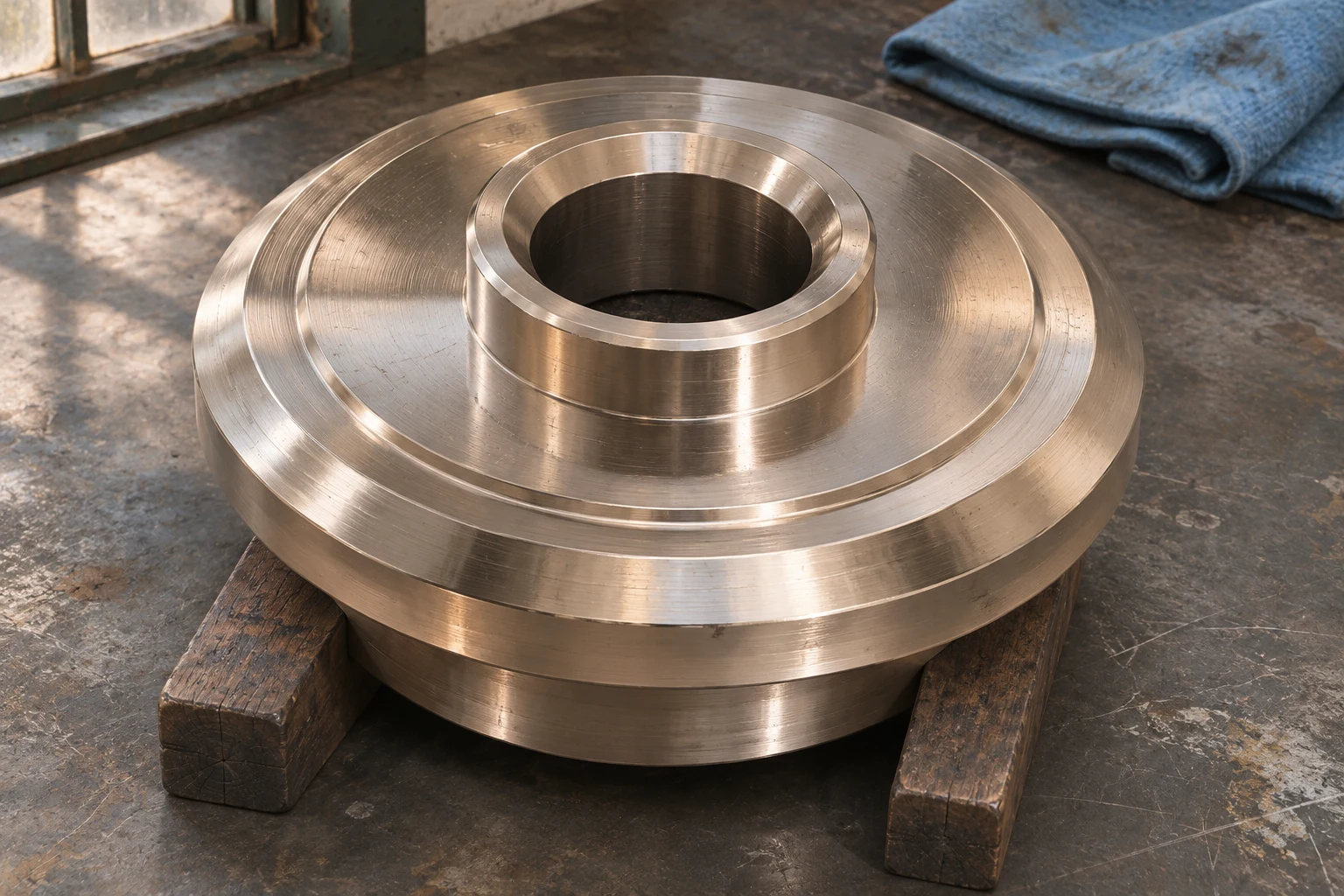
“Bronze worm gear blank” can mean a rough casting awaiting turning or a machined blank ready for tooth cutting. Those deliveries arrive at different points in the gear maker's process. They should not be compared as if only the supplier name changed.
The useful question is what operation happens next. If the next machine is a lathe, the enquiry needs a casting definition. If the next operation is hobbing, it needs the agreed pre-cutting blank definition.
The blank is not the finished toothed wheel
A US supplier's gear blank page describes cast and machined blanks supplied for subsequent cutting, shaping or hobbing. AW Fraser also describes machined bronze blanks for worm drives that still require specialist hobbing. These are examples of a manufacturing handoff: the teeth belong to a later stage.
A smooth rim is therefore expected on a pre-tooth-cutting blank. It is not a missing-feature defect simply because the final wheel drawing shows teeth. Equally, a casting that resembles the wheel's overall envelope is not automatically ready to go onto the gear cutter.
On a small screen, scroll the table sideways.
| Requested delivery | What the purchase definition needs to distinguish | Work still outside that definition |
|---|---|---|
| As-cast blank | Cast geometry and stock for subsequent machining | Turning, boring and tooth cutting as assigned |
| Machined blank before tooth cutting | Finished locating features and deliberately retained stock | Tooth cutting and any specified later finishing |
| Finished toothed wheel | The completed wheel and tooth requirements | Different supply scope from an uncut blank |
Give the cutter usable references
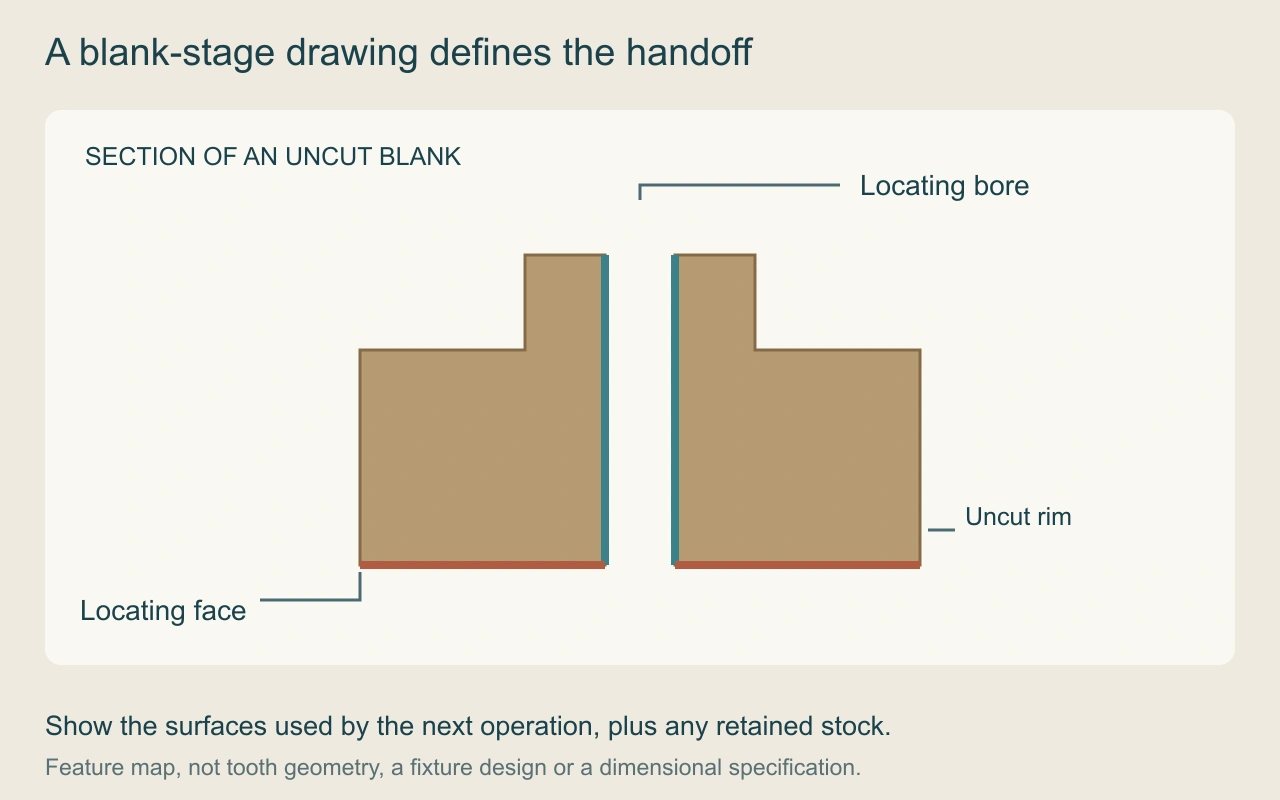
The bore and locating face do more than complete the blank's outline. They provide references for its next setup. Wexmar's gear-blank feature explanation identifies the bore, locating face, OD relationship and stock allowance as separate manufacturing considerations.
Imagine a blank whose outside diameter is correct but whose intended locating face has not been finished. Its size alone does not establish that the next setup can locate from that face. The same issue arises when the buyer expects a finished bore but the supplier's scope leaves it for later boring.
Agree what is finished at receipt
Use a blank-stage drawing alongside the finished-wheel reference. Mark the surfaces finished for the next setup and any surfaces retaining stock. A dimension taken from the finished wheel should not silently replace the blank-stage requirement when another operation is still planned.
For a custom casting enquiry, identify whether you need the as-cast form or a machined pre-cutting blank, and show the bore and locating face used by the next operation. Continue through the bronze worm-wheel blank page. That keeps a quotation for an uncut blank distinct from a quotation for a finished gear.