
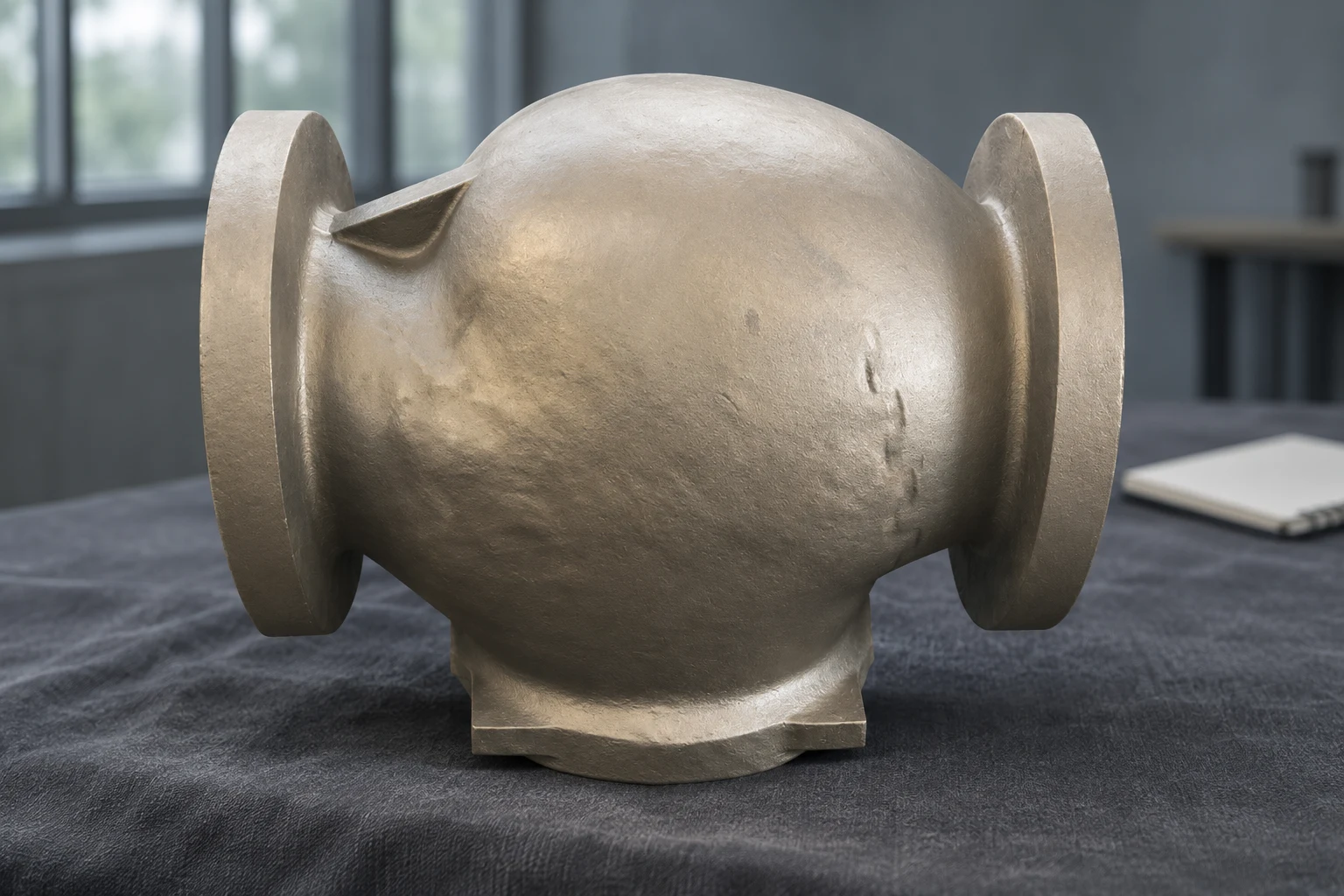
“Machined valve body” can mean a casting with finished pipe ends, a body ready to receive its trim, or a more complete set of finished interfaces. Those are different supply states.
For bronze valve body machining, start with the surfaces that perform a defined job. This article focuses on a globe-style body: the seat region, body-to-bonnet connection and pipe ends. A ball-valve or butterfly-valve body needs a different feature map.
Locate the actual shutoff seat first
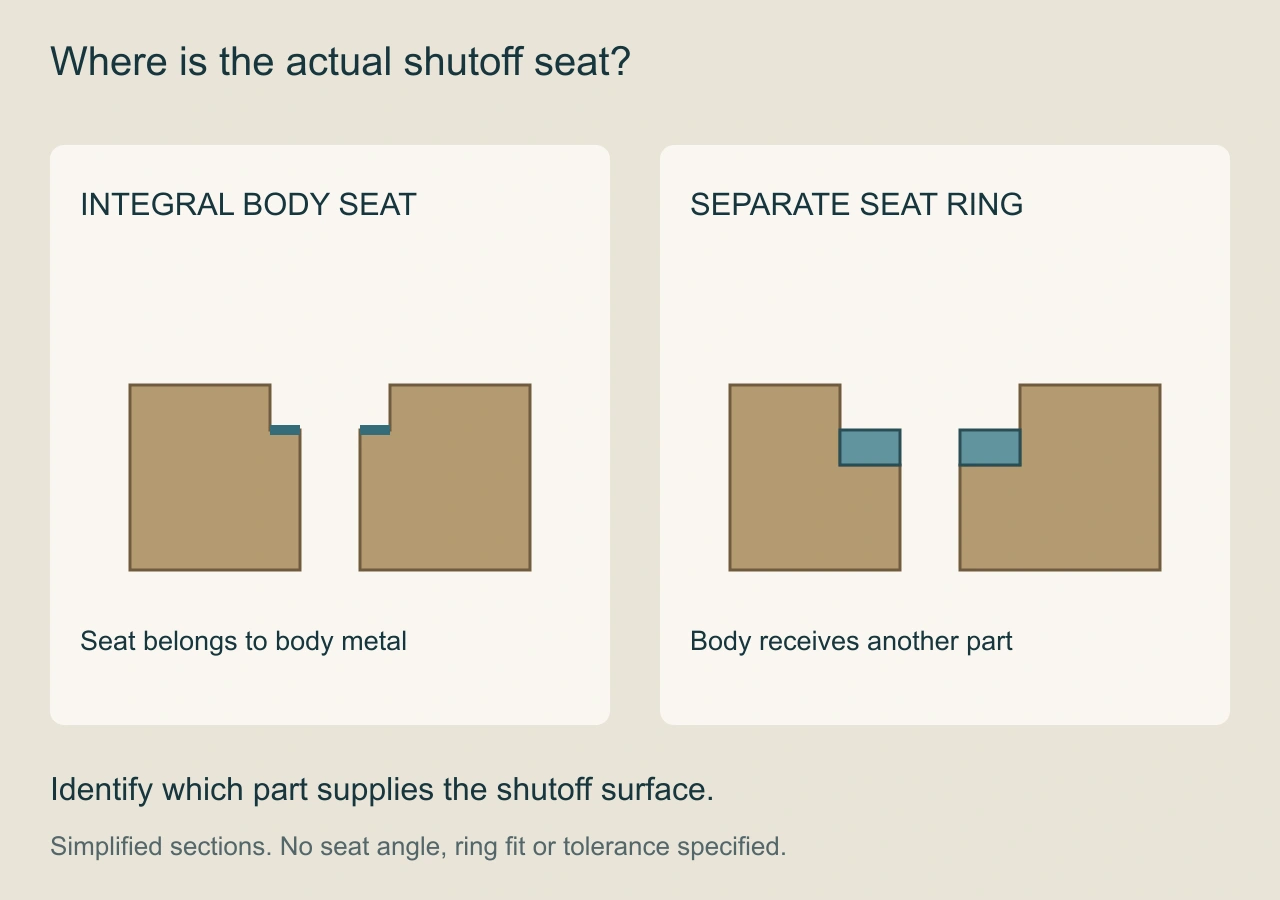
An integral seat is formed in the body itself. With a separate seat ring, the body instead provides the interface that receives that ring. Machining the ring's receiving feature and finishing the surface that contacts the closing disc are not automatically the same operation.
These are real architectural alternatives. NIBCO identifies an integral seat in its S-235-Y bronze globe valve. Fisher's EZ valve manual provides a separate seat-ring example. The examples explain the distinction; they do not make their components interchangeable or transfer a steel valve's dimensions to a bronze casting.
An inspection point called “seat diameter” is incomplete until the feature is identified. Is it the body seat, the ring pocket, or a diameter on the separate ring? A correct value measured on the wrong feature does not resolve the assembly question.
Give each surface its own delivery condition
The flow passage and the assembly interfaces need not share a finish instruction. A passage that remains as-cast still has a controlled shape. Conversely, an end that looks smooth is not necessarily a finished thread, socket or flange face.
On a small screen, scroll the table sideways.
| Body region | Question that defines the machining scope |
|---|---|
| Integral seat or separate-ring interface | Which part supplies the shutoff surface, and which body surfaces locate it? |
| Bonnet connection | Is the attachment screwed, union-retained or bolted, and which surfaces make the joint? |
| Pipe ends | Which finished connection geometry is required on this body? |
| Internal passage | Which contour remains as-cast, and where does it meet a finished feature? |
The bonnet connection deserves its own section view. NIBCO's bronze globe-valve instructions, section 1.3, describe screwed and union arrangements with different attachment features. A generic instruction to machine a bonnet flange would not describe both. The matching valve bonnet product scope is therefore useful alongside the body definition.
Machining stock should follow this feature map. Extra metal belongs on a surface scheduled for removal; it should not silently change a passage that is meant to remain as-cast. Nor does polishing the surrounding casting establish the position of a seat relative to its mating components.
For a custom body inquiry, mark the seat construction and indicate which of these interfaces are included in the supplied condition. Use the bronze valve body casting page to carry that scope into the inquiry. A marked section is more useful here than the blanket instruction “fully machine.”