
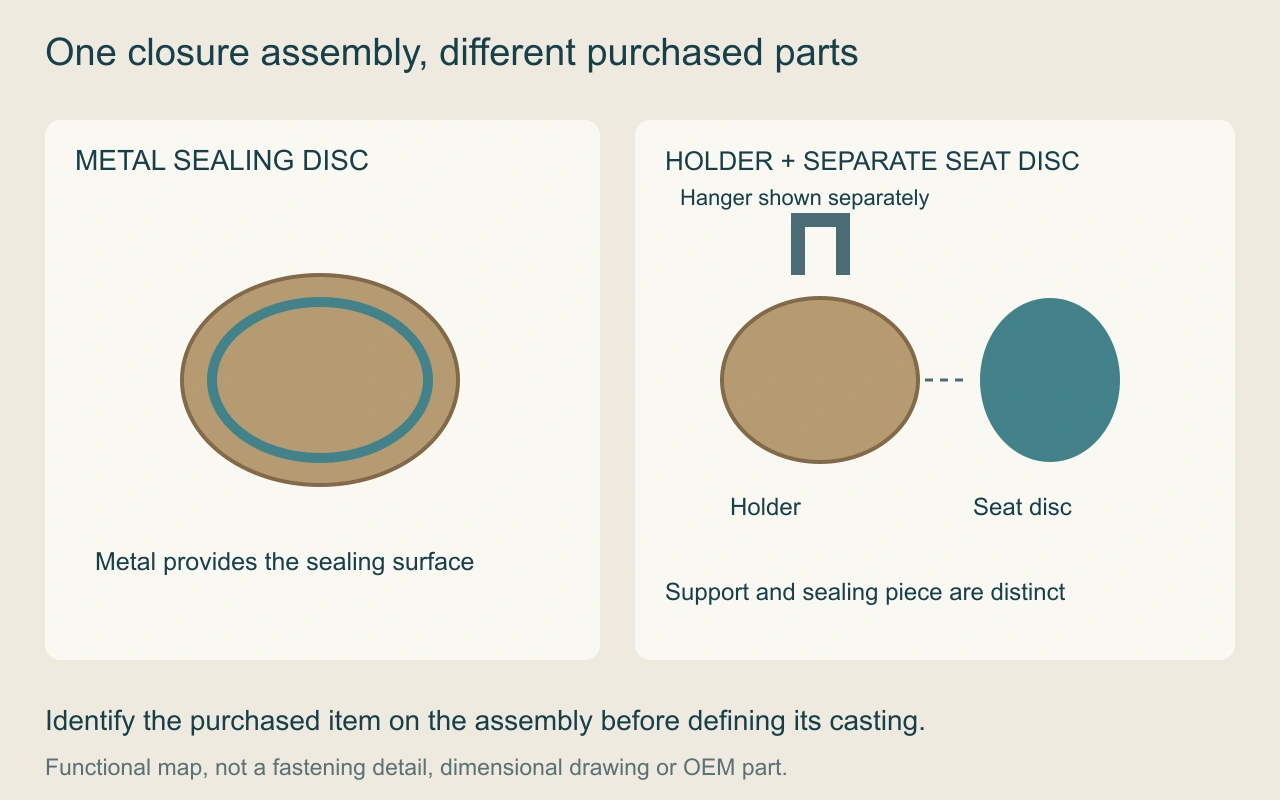
The phrase bronze check valve disc can identify the wrong purchased part if the assembly drawing is missing. In one construction, the metal disc provides the sealing surface. In another, a metal holder carries a separate sealing piece. A swing hanger can be a third component.
Before sending a casting enquiry, identify which of those parts the enquiry actually covers. Their functions meet in one assembly, but their manufacturing interfaces are different.
Follow the part that touches the stationary seat
A check valve closes when its moving closure meets the stationary seat. Trace that contact first. Does the bronze component itself meet the seat, or does it support a separate seat disc?
NIBCO's Bronze & Iron Valves catalog, printed page 31, provides a concrete example. Its bronze swing-check parts list distinguishes a disc hanger, disc holder, seat disc and retaining items. The listed configurations include bronze and nonmetallic seat discs. The component names therefore describe an assembly relationship, not one universal bronze casting.
For a metal sealing disc, the functional surface is part of the metal component. For a holder carrying a separate sealing piece, the important local features include the support and attachment for that piece. Describing both items simply as “the disc” conceals which surface the casting supplier is being asked to provide.
The hanger is another boundary
The hanger connects the moving closure to its swing arrangement. It should not be merged into the disc-holder purchase scope just because the parts move together.
On an exploded drawing, circle the item being purchased and keep the neighboring parts visible. That shows whether the bronze casting includes an attachment feature, receives another component or is supplied as part of an assembly. A detached photograph of a round metal piece rarely answers all three questions.
Match the enquiry to the component drawing
Two documents do different jobs here. The assembly or exploded view identifies the component. Its detail drawing defines the component to manufacture.
For a sealing disc, mark the face that meets the stationary seat. For a holder, show the receiving surface and the feature that retains the separate seat disc. For either construction, identify the connection to the hanger as it appears in the released design. These details prevent a casting quotation from silently becoming a quotation for a different part or a complete moving assembly.
The stationary seat belongs to the other side of the closure. If you are also defining the body, the distinction between an integral body seat and a separate seat ring is a separate machining question. It does not replace the moving-part definition.
For your next enquiry, send the circled assembly item and its component drawing through the bronze valve disc casting page. State whether the requested supply is the metal disc, the holder or an identified assembly, and whether it is a casting blank or a machined component. That keeps the enquiry tied to the part you actually intend to buy.