
A basket strainer can have a sound cover joint while its basket sits incorrectly inside the body. It can also have a correctly located basket and a problem at the cover joint. The two interfaces serve different purposes.
When defining a bronze strainer body casting, separate the internal basket location from the outer cover seal. Calling both of them a “seat” is too vague for a component drawing or machining enquiry.
Inside: locate the basket in its intended flow path
The basket seat supports or locates the basket according to the particular strainer design. Its geometry establishes where the basket sits relative to the surrounding body and adjoining components.
Eaton's Model 73 installation and maintenance manual, under Basket Replacement on printed page 3, calls for the basket to seat squarely. It also describes the cover compressing the basket handle in that design. The example matters because the basket position is an assembled relationship, not just the diameter of a ledge in an empty casting.
Other retention arrangements require their own section and component definition. The Eaton example does not establish that every basket is held down by its handle, or that every basket seat uses a fluid-tight seal.
If a gap around the basket connects the upstream side directly to the downstream side, it creates an alternate internal path around the filtering surface. Whether such a path exists depends on the actual body and basket geometry. A photograph of the closed strainer cannot show that relationship.
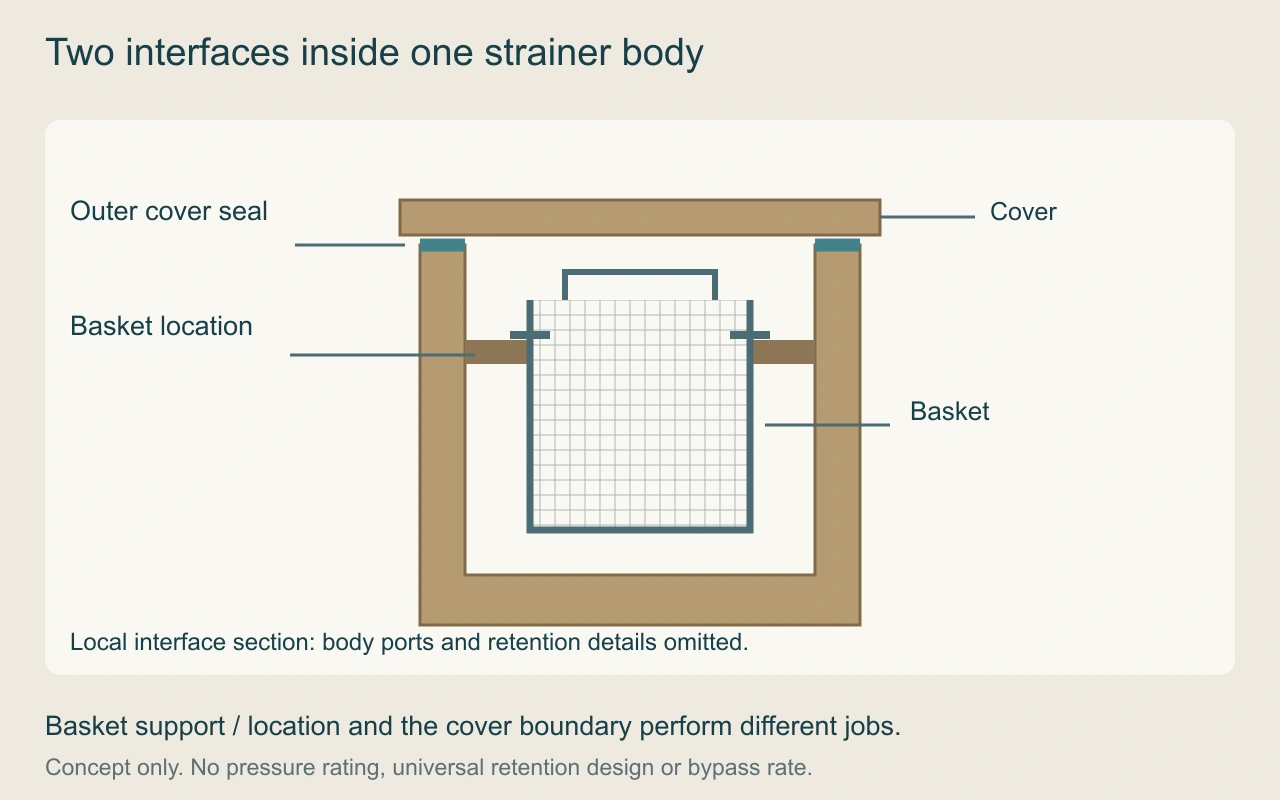
Outside: close the housing
The cover seal closes the body to the surrounding environment. The same Eaton manual separately discusses the cover O-ring and its machined contact surface. That is a different interface from the basket seating inside the body.
This distinction also separates two observations. Fluid escaping at the cover is an external boundary issue. An internal path around the filtering surface concerns where fluid travels within the assembled strainer. One observation does not, by itself, establish the condition of the other interface.
For the body definition, identify the cover's mating surface and any seal location in the released design. Separately identify the feature that receives the basket. Do not use a single surface note to stand in for both jobs.
Show the assembled stack, then the body alone
A useful enquiry pairs a section through the assembled basket and cover with the body component drawing. The section explains the relationships; the detail drawing identifies what belongs to the casting being ordered.
Show which basket feature locates against the body, how the basket is retained in the actual assembly, and where the cover seal acts. If the request is for a casting blank, distinguish machining stock from the final receiving and sealing surfaces. If it is for a machined body, identify those finished surfaces on the component drawing.
Use the strainer body casting page for the custom enquiry. An assembly section and the body drawing give the discussion a clear starting point: one internal basket interface, one outer cover joint, and a defined component supply.