
A pump shaft sleeve can fit the shaft perfectly and still have the wrong outside surface for the adjoining component. Its bore answers one question: how does the sleeve mount? The working outside diameter answers another: where does the seal or bearing run?
For a bronze pump shaft sleeve, identify that working surface before treating the part as a simple tube. Its axial position matters as well as its diameter.
The bore and the working OD do different jobs
OD means outside diameter; ID means inside diameter. On a protective sleeve, the ID receives the shaft. An OD band can face a seal or a bearing, depending on the assembly. That band is a functional surface, not merely the outside of the casting.
KSB's shaft-protecting sleeve definition describes a sleeve fitted on the shaft and running inside a bearing bush. It also explains the shaft-protection role around seals and bearings. A US manufacturer similarly uses shaft sleeve for components that protect pump and compressor shafts, including their seal running surfaces.
Neither description makes a shaft sleeve and a sleeve bearing interchangeable names. In the arrangement KSB describes, they are adjoining components: the protective sleeve turns with the shaft inside the bearing bush. Check the assembly rather than deciding from a photograph of two cylindrical parts.
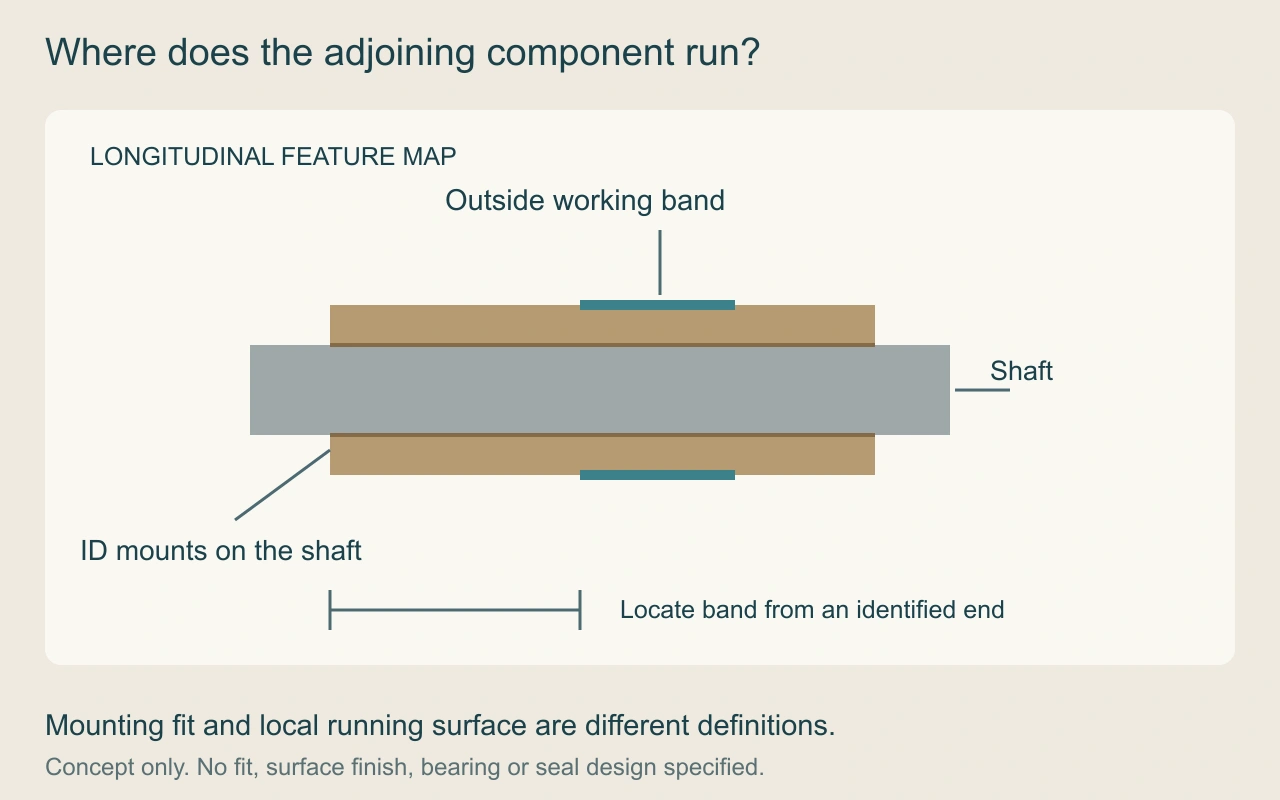
Mark where the adjoining part actually runs
Suppose two sleeves have the same bore and overall length. One drawing places a finished OD band near the shoulder; the other places it farther along the sleeve. Those drawings describe different local interfaces even if a basic size comparison looks identical.
A local assembly section makes that difference visible. Show the adjoining seal or bush, the sleeve end or shoulder used as the axial reference, and the extent of the working band. Then the component drawing can assign the applicable diameter, finish and geometric requirements to the intended surface.
Do not let a general “machine OD” note hide a step, relief or transition within that zone. The point is to identify which feature the adjoining component encounters, rather than apply one finish instruction to every outside surface.
Keep the supplied state clear
A cast sleeve blank can retain stock where a finished sleeve has a working surface. Compare like stages: a cast OD with machining allowance is not the final running diameter, and an unfinished bore is not the mounting fit.
For a custom enquiry, show the working band and its axial reference on the sleeve drawing, with a local assembly section identifying the adjoining part. State whether the requested delivery is a casting blank or a machined sleeve. The pump shaft sleeve page provides the product route for that enquiry. These details focus the discussion on the surfaces the assembly actually uses.