COMPONENT REQUIREMENTS

Control valve body

Define the geometry, material, delivery condition and acceptance criteria for the selected application. Manufacturing scope requires review of the approved drawing and operating requirements.

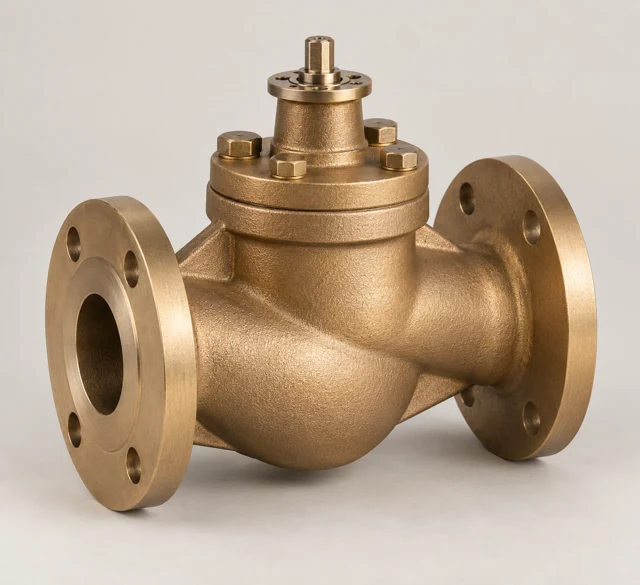
Illustrative Control valve body
Generated component illustration. It is not a Zhiren product photograph or an engineering drawing; final geometry follows the controlled drawing.
Illustrative Control valve body
Conceptual part illustration
COMPONENT GUIDE

Control valve body

Closed hot-water or chilled-water control valve

Contains the water-side flow passage and locates the valve seat and connections.

Manufacturing & delivery form
Casting with drawing-defined port and sealing-face machining.

The complete valve sets flow, control and pressure performance. A catalogue rating or glycol limit cannot become a general casting rating.

Material candidates

Rg5 Gunmetal

An OEM-specified gunmetal option for control-valve bodies.

An OEM example only. Confirm the governing material standard and manufacturing condition; do not assume equivalence with C83600 or CC491K.

EN CC491K Leaded tin-zinc bronze / gunmetal

A candidate for specified water-side valve bodies and housings.

Confirm separately from UNS grades. Lead restrictions, medium, material standard and casting route require approval.

UNS C83600 Leaded red brass

A candidate for specified cast valve bodies, covers and connection housings.

An application candidate, not a confirmed equipment bill of materials or available Zhiren grade. Do not default to potable-water use.

Confirm the drawing, actual duty, material standard and manufacturing condition. Material substitutions require customer approval, and supply scope is agreed after component review.

Component RFQ requirements

Valve layout
Provide the approved body drawing, valve configuration, flow direction, seat datum and machining allowance.
Ports and interfaces
Define thread or flange standards, face-to-face dimensions, actuator/bonnet interface and sealing faces.
Fluid and cycling
Identify closed heating or chilled water, water treatment, glycol type and concentration, and operating temperature cycles.
Pressure and acceptance
Specify design pressure/temperature, pressure-boundary defect criteria, leak-test method, limits and responsible party.
Delivery and records
State blank, rough or finished condition, quantity, material standard and required traceability records.

Start with your drawing, specified alloy and quantity. Include the required delivery condition and acceptance records so the manufacturing and inspection scope can be reviewed.

Prepare a component enquiry
FURTHER GUIDANCE

Prepare the technical RFQ.

Alloy reference

Review tin-bronze grades.

Compare reference grades and composition in the alloy catalogue. Use the approved component specification to determine the required alloy and service suitability.

Explore the alloy reference