COMPONENT REQUIREMENTS

Thrust washer / locating ring

Define the geometry, material, delivery condition and acceptance criteria for the selected application. Manufacturing scope requires review of the approved drawing and operating requirements.

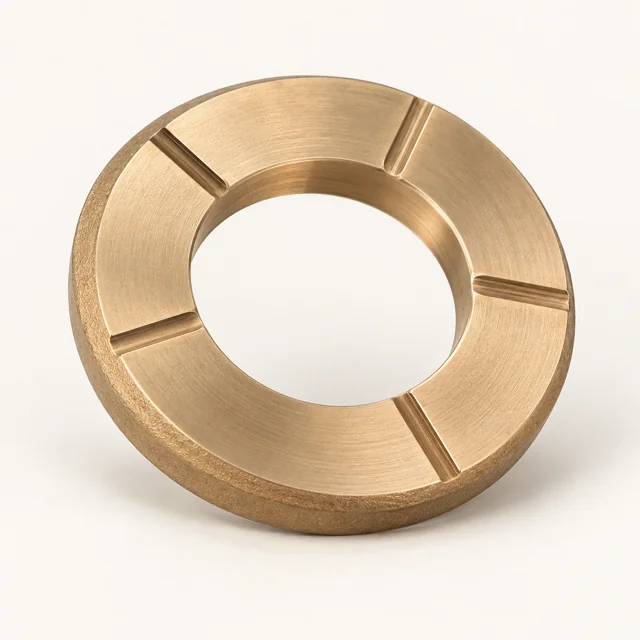
Illustrative Thrust washer / locating ring
Generated component illustration. It is not a Zhiren product photograph or an engineering drawing; final geometry follows the controlled drawing.
Illustrative Thrust washer / locating ring
Conceptual part illustration
COMPONENT GUIDE

Thrust washer / locating ring

Auxiliary shaft or local axial contact within mill equipment.

Provides the drawing-defined axial contact face or locating function.

Manufacturing & delivery form
Ring blank or machining from suitable plate/tube stock; route to be agreed.

A locating ring does not necessarily carry thrust. Name and assess the component according to its actual function.

Material candidates

UNS C93200 Leaded tin bronze

Candidate for lubricated bushings, bearings and thrust interfaces.

Contains lead. Confirm load, speed, shaft condition and lubrication; no dry-running capability is implied.

UNS C95400 Aluminium bronze

Candidate for drawing-defined loaded sliding and wear components.

Review mating material, lubrication and supply condition. C95400 and C95800 are distinct grades.

UNS C86300 Manganese brass / manganese bronze

Candidate for specified heavily loaded sliding parts and nut blanks.

A high-strength brass family, not tin bronze. Confirm the counterface and lubrication; no universal wear-life claim applies.

Confirm the drawing, actual duty, material standard and manufacturing condition. Material substitutions require customer approval, and supply scope is agreed after component review.

Component RFQ requirements

Ring geometry
Inside/outside diameters, thickness, grooves and locating features.
Contact faces
Flatness, parallelism, finish and mating materials.
Axial function
Locating or thrust duty, load and relative motion.
Lubrication & heat
Lubricant, contact temperature and operating cycle.
Material & acceptance
Specified alloy and standard, supply condition, drawing revision, quantity, inspection criteria and required records.
Supply form
Ring blank or machining from suitable plate/tube stock; route to be agreed.

Start with your drawing, specified alloy and quantity. Include the required delivery condition and acceptance records so the manufacturing and inspection scope can be reviewed.

Prepare a component enquiry
FURTHER GUIDANCE

Prepare the technical RFQ.

Alloy reference

Review tin-bronze grades.

Compare reference grades and composition in the alloy catalogue. Use the approved component specification to determine the required alloy and service suitability.

Explore the alloy reference